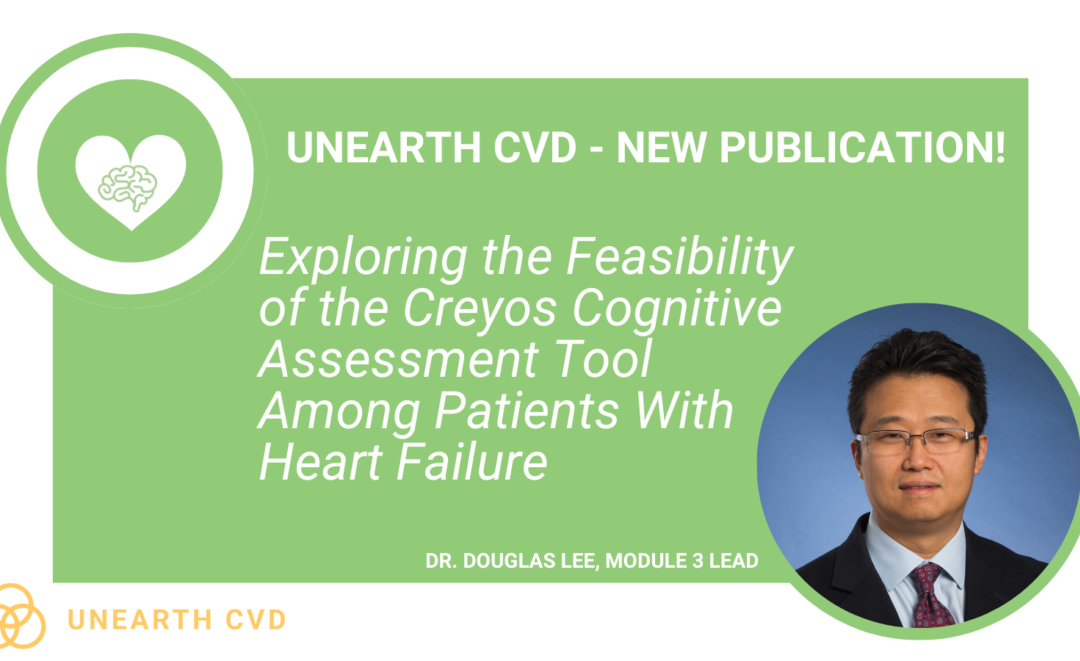
New findings from the UNEARTH CVD research team have shed light on an important but often overlooked aspect of cardiovascular care: the cognitive health of people living with heart failure. Published in Cureus, this new publication is the first study to examine whether a fully digital cognitive assessment can be reliably used in this patient population. Led by Dr. Douglas Lee (UHN, University of Toronto) and Joann Varickanickal (UHN), with collaborators across neurology, cardiology, psychiatry, and data science, this exciting work highlights both the promise of innovative tools and the complexity of managing heart failure beyond the heart itself.
A New Lens on Cognitive Health
Cognitive impairment is common amongst people with heart failure, often affecting memory, reasoning, and the ability to manage self-care routines. Despite this, cognitive testing in clinical environments is often limited by time, staffing, and the availability of sensitive tools.
Recognizing the need for more accessible testing, the UNEARTH CVD team set out to evaluate Creyos, an online tablet- and computer-based cognitive test, as a potential solution. Forty participants took part, including 30 people with heart failure and 10 healthy controls, all of whom completed a series of 12 short tasks measuring concentration, memory, verbal reasoning, and problem-solving.
“The relationship between heart failure and cognitive decline is recognized, but detecting early changes is challenging,” says Dr. Douglas Lee. “Digital tools like Creyos could help us identify issues sooner in a way that is less burdensome for patients and care providers.”
An Encouraging Patient and Provider Experience
One of the most notable findings was that 89% of participants completed all 12 digital tests, finishing the full assessment in about half an hour. Participants could complete the tests either at home or in a clinic, an option provided for individuals with limited access to or comfort with technology.
Overall, patients reported a positive experience: the majority found the tool easy and intuitive to use. A small number of participants required technical help, highlighting that future studies should have the resources to support these patients if needed.“That people with heart failure—many of whom are older adults—were able to use this digital tool so effectively speaks to its potential,” notes Dr. Lee. “It suggests real-world applicability, both for research and potentially for clinical screening.”
Creyos Helped Reveal Important Patterns in Cognitive Function
When the team compared their results to a large age- and sex-matched healthy population, important differences emerged. Participants with heart failure showed the most notable impairments in reasoning and problem-solving, as well as verbal processing and language-based thinking. These types of cognitive challenges can directly impact a patient’s ability to manage medications, follow instructions, and recognize early signs of worsening heart failure.
Interestingly, despite these deficits, participants performed better than healthy norms on tests of short-term memory, a finding that warrants further study.
Lee emphasized the importance of these patterns. “Understanding which aspects of cognition are affected can help us design better supports that will make a meaningful difference for these patients.”
A Call for Further Cardiovascular Cognitive Testing Research
The UNEARTH CVD team views this feasibility study as a critical first step toward integrating more sophisticated cognitive assessments into heart failure care and research. With strong completion rates and positive patient feedback, the Creyos test offers a glimpse of how digital assessment tools may bridge existing gaps in early cognitive impairment detection.
“This work highlights the need for scalable, accessible tools to monitor cognitive health in the heart failure population,” says Dr. Lee. “Understanding the heart–brain connection is essential for improving long-term outcomes, and studies like this move us closer to personalized, proactive care.”
Lead author, Joann Varickanickal, noted that larger and more diverse studies are needed to validate these findings, explore long-term cognitive trends, and examine how digital tools can complement traditional assessments. She also emphasized the importance of accessibility, particularly for patients with lower digital literacy or limited access to technology.
Still, the results offer an exciting foundation.
“Feasibility studies like this are essential,” says Varickanickal. “They help us understand what’s possible, and where we can go next.”
Congratulations to the UNEARTH CVD team on this exciting study! We look forward to seeing future work that continues to deepen our understanding of the heart–brain connection, ultimately helping to improve the quality of life for people living with heart failure.