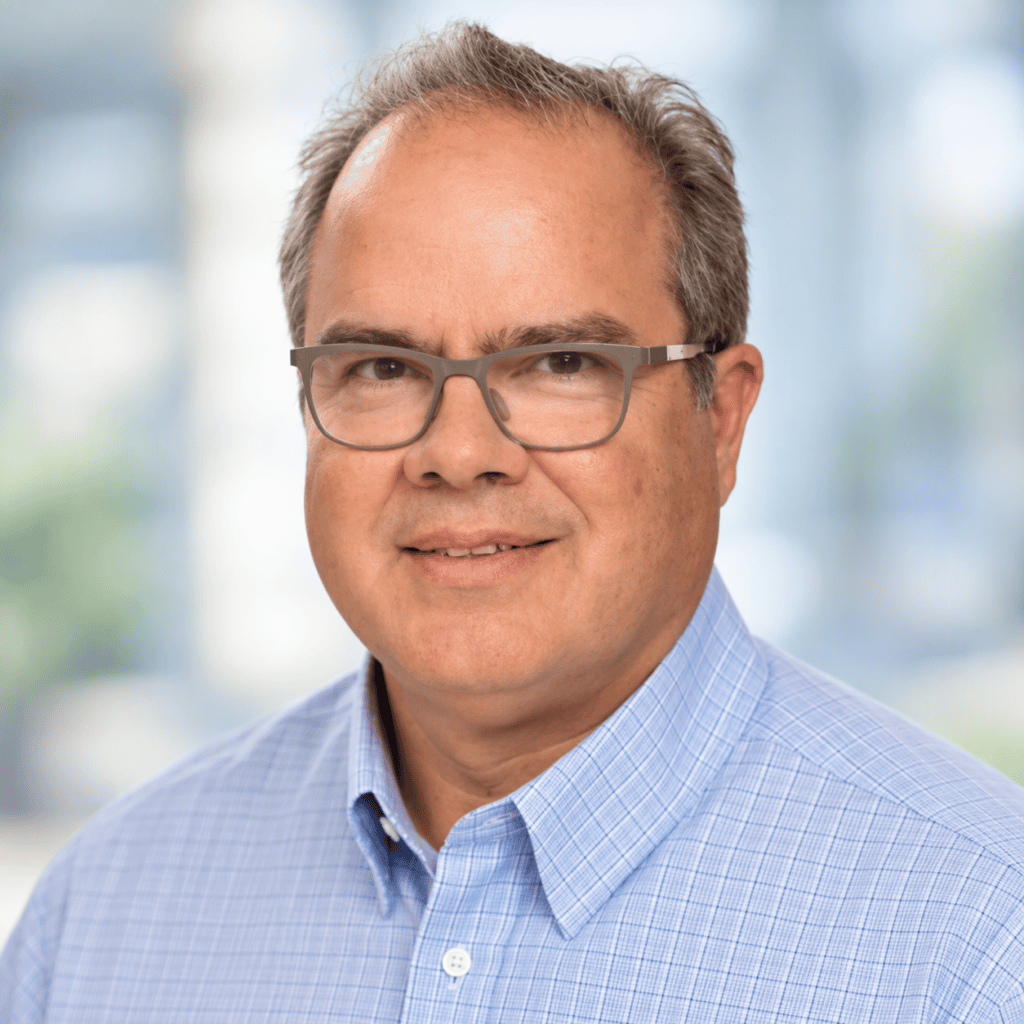
Middle-aged man with glasses wearing a light blue button-down shirt.

Robert Hamilton

MD, FRCP(C), MHSc

  • Head, Cardiovascular Research, Labatt Family Heart Centre, SickKids
  • Senior Associate Scientist, Translational Medicine, SickKids
  • Professor, Paediatrics, University of Toronto

Research Focus Areas

  • Cardiac Biomarkers
  • Inherited Arrhythmia
  • Sudden Cardiac Death

Overview

Robert Hamilton is a Senior Associate Scientist in Translational Medicine at SickKids and a Professor in the Department of Paediatrics at the University of Toronto. His research interests center on inherited arrhythmia, cardiac biomarkers, and sudden cardiac death, developing blood- and saliva-based diagnostic tests for conditions that standard genetic testing often cannot confirm.

Among his most significant findings, in 2017 he identified a novel biomarker for Arrhythmogenic Right Ventricular Cardiomyopathy, presented at the European Society of Cardiology and published in the European Heart Journal, and he later identified a related biomarker for Brugada Syndrome, presented at the American Heart Association. His tests, based on autoantibodies against specific cardiac proteins, detect more than 98 percent of ARVC and Brugada Syndrome cases regardless of whether a genetic cause can be found. He received the Sustained Research Excellence Award from the SickKids Department of Paediatrics in 2023.

He is a children’s cardiologist and senior electrophysiologist who has spent decades managing an inherited arrhythmia clinic, clinical experience that directly motivated his biomarker discoveries, and is affiliated with the Ontario Institute for Regenerative Medicine.

Collaborators would find his biomarker tests particularly valuable for diagnosing inherited arrhythmias when genetic testing finds no cause.

Published Research

Showing 4 out of 21 results

  • Clinical value of anti-desmoglein-2 antibodies in arrhythmogenic right ventricular cardiomyopathy: real-world evidence

    2026 | Europace

    Shaylyn Joseph, Karolina Borowiec, Olgierd Woźniak, Diptendu Chatterjee, Meena Fatah, Vivian Silbiger, Ilona Kowalik, Urszula Skrzypczyńska-Banasik, Ewa Kowalik, Mirosław Kowalski, Elżbieta Katarzyna Biernacka, Robert M Hamilton

  • Anti‐desmoglein‐2 autoantibodies do not discriminate between UK boxer dogs with and without arrhythmogenic right ventricular cardiomyopathy

    2025 | Veterinary Record

    Chia‐Hsuan Chang, Claire Watson, Diptendu Chatterjee, Jade Ward, Kieran Borgeat, Hannah Hodgkiss‐Geere, Joanna Dukes‐McEwan, Robert Hamilton, Melanie J. Hezzell

  • Intellectual and Neurodevelopmental Delays in Pediatric Catecholaminergic Polymorphic Ventricular Tachycardia: Distinct Characteristics and a More Malignant Neurocardiac Phenotype

    2025 | Circulation: Arrhythmia and Electrophysiology

    Christina Y. Miyake, Dania Kallas, Sara B. Stephens, Oliver M. Moore, Xander H.T. Wehrens, Peter S. Fischbach, Martin J. LaPage, Andrew P. Landstrom, Ian H. Law, Allison C. Hill, Prince J. Kannankeril, Frank A. Fish, Taylor S. Howard, Santiago O. Valdes, Tam Dan N. Pham, Jeffrey J. Kim, Santokh S. Dhillon, Christopher L. Johnsrude, Ulrich Krause, Georgia Sarquella-Brugada, Peter Kubuš, Terezia Tavacova, Sit-Yee Kwok, Susan P. Etheridge, Svjetlana Tisma-Dupanovic, Adam C. Kean, Andrew D. Krahn, Mohammed A. Ebrahim, Joseph Atallah, Anne Fournier, Anjan S. Batra, Ming-Lon Young, James Perry, Joshua R. Kovach, Anna N. Kamp, Bradley C. Clark, Erick Jimenez, Fatme Charafeddine, Robert M. Hamilton, Seshadri Balaji, Shubhayan Sanatani

  • Robotic manipulation of cardiomyocytes to identify gap junction modifiers for arrhythmogenic cardiomyopathy.

    2024 | Science robotics

    Wenkun Dou, Guanqiao Shan, Qili Zhao, Manpreet Malhi, Aojun Jiang, Zhuoran Zhang, Andrés González-Guerra, Shaojie Fu, Junhui Law, Robert M. Hamilton, Juan A. Bernal, Xinyu Liu, Yu Sun, Jason T. Maynes

Research Laboratory

The Hamilton lab investigates inherited, congenital, and acquired rhythm disorders of the heart, with a focus on developing accurate, non-genetic biomarkers as well as gene discovery for conditions including arrhythmogenic right ventricular cardiomyopathy (ARVC), Brugada Syndrome, congenital heart block, catecholaminergic polymorphic ventricular tachycardia, cardiac sarcoidosis, and peripartum cardiomyopathy. The lab’s central insight, built over decades of clinical experience in an inherited arrhythmia clinic, is that many of these conditions are likely substantially underdiagnosed because the responsible genes often cannot be identified in affected families using standard genetic testing, leaving clinicians without a reliable way to confirm a diagnosis. In response, the lab develops blood- and saliva-based diagnostic tests built around autoantibodies against specific cardiac proteins that do not depend on finding a causative gene: in 2017 the lab discovered a novel biomarker for ARVC, and has since identified a related biomarker for Brugada Syndrome, together detecting more than 98 percent of ARVC and Brugada Syndrome cases regardless of underlying genetic cause. These tests are being translated toward clinical diagnostic laboratories, aiming to give families a definitive answer where genetic testing alone leaves uncertainty, and enable earlier treatment to prevent sudden cardiac death.
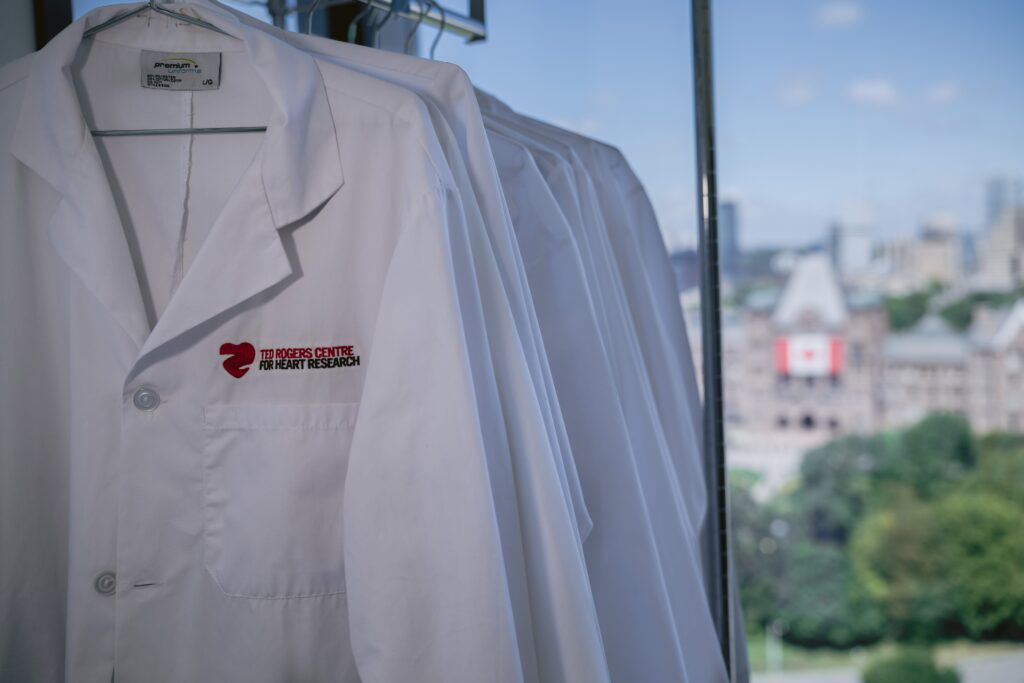

White lab coats with a Ted Rogers Centre for Heart Research logo hanging on a rack before a window overlooking the city, capturing life at the Ted Rogers Centre.