
The Emergency Heart Failure Mortality Risk Grade (EHMRG) Score
Understanding the EHMRG Score
The EHMRG score generates a personalized 7- and 30-day mortality risk for each patient, empowering physicians to discharge low-risk patients quickly while ensuring high-risk patients are appropriately admitted to stabilize their heart failure. Developed by Dr. Douglas Lee, the Ted Rogers Chair in Heart Function Outcomes, the tool supplements clinical judgement with validated, objective risk estimates for a more personalized approach to care. It’s now successfully integrated into UHN’s emergency departments through Epic’s electronic medical record system, and available to cardiologists and emergency physicians in EDs across Canada through a web-based calculator.

EHMRG Success by the Numbers
EHMRG is backed by over a decade of clinical evidence, from its first validation in Circulation to the large-scale COACH trial, which tested the score across 10 Ontario hospitals and found it significantly reduced adverse outcomes for people with acute heart failure.
-
patients studied across 10 hospitals in the COACH trial
5,000+
-
death or hospitalization rate with EHMRG, vs. 14.5% usual care
12.10%
-
EHMRG integration into an EMR system in Canada
1st
The EHMRG Score Evidence


-
The goal of the tool is to empower physicians to discharge low-risk patients quickly. This improves their quality of life, preserves resources for higher-risk patients, and saves significant health-care costs, while also ensuring high-risk patients are appropriately admitted to stabilize their heart failure. EHMRG supplements clinical judgement with validated, objective estimates of risk, supporting a more personalized approach to patient care. The risk calculator was first proven effective in a study published in Circulation in 2012, and was developed by Dr. Douglas Lee, the Ted Rogers Chair in Heart Function Outcomes and a Senior Scientist at the Institute for Clinical Evaluative Sciences.

-
Following initial success, a randomized trial across 10 Ontario hospitals with over 5,000 patients, known as the COACH trial, compared usual emergency department care with the EHMRG score for managing acute heart failure. The results were promising: only 12.1% of patients in the intervention group experienced death or cardiovascular hospitalization within 30 days, compared to 14.5% in the control group. The EHMRG score also showed improved long-term outcomes over 20 months. These findings supported integrating the tool into UHN’s EMR system, where it has been helping emergency physicians manage heart failure patients ever since.
Launch the Emergency Heart Failure Mortality Risk (EHMRG) Calculator
Explore the Toolkit


-
Implementing EHMRG at UHN
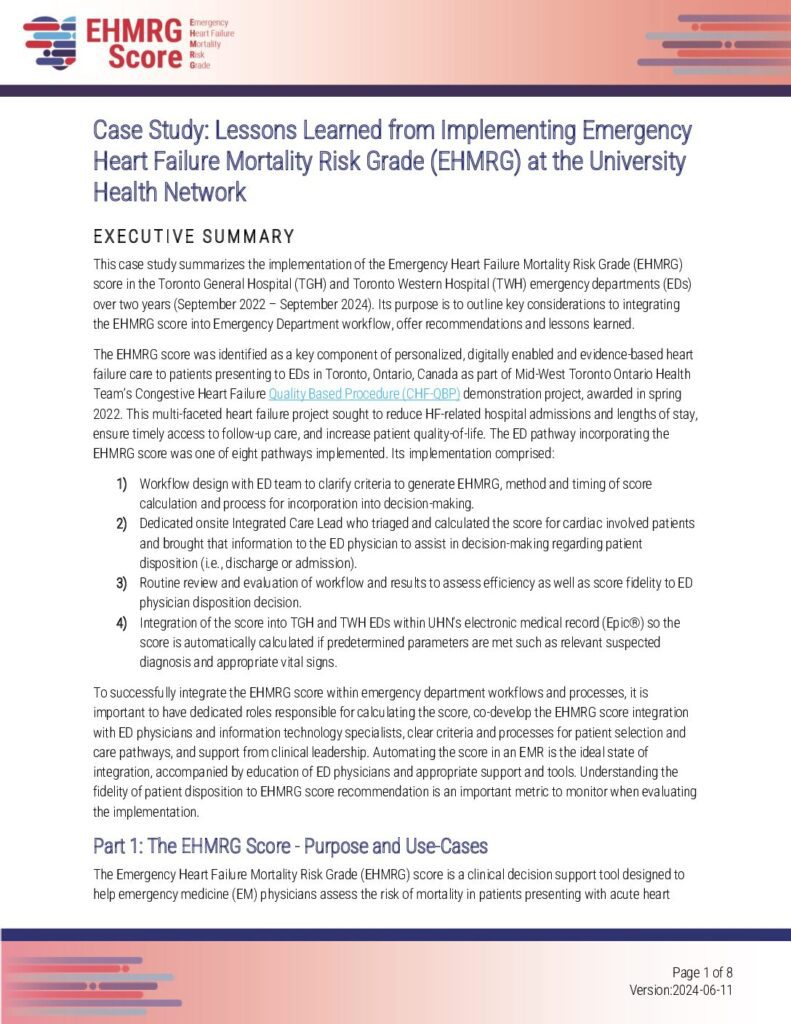
Curious about how the UHN emergency departments successfully integrated the EHMRG Calculator into their workflow?
Download the Case Study to learn about:
- The ED pathway design and components
- The role of the Integrated Care lead
- How EHMRG is generated and reviewed
- Impact on patient disposition decision-making
- Lessons learned and potential pitfalls to watch for
-
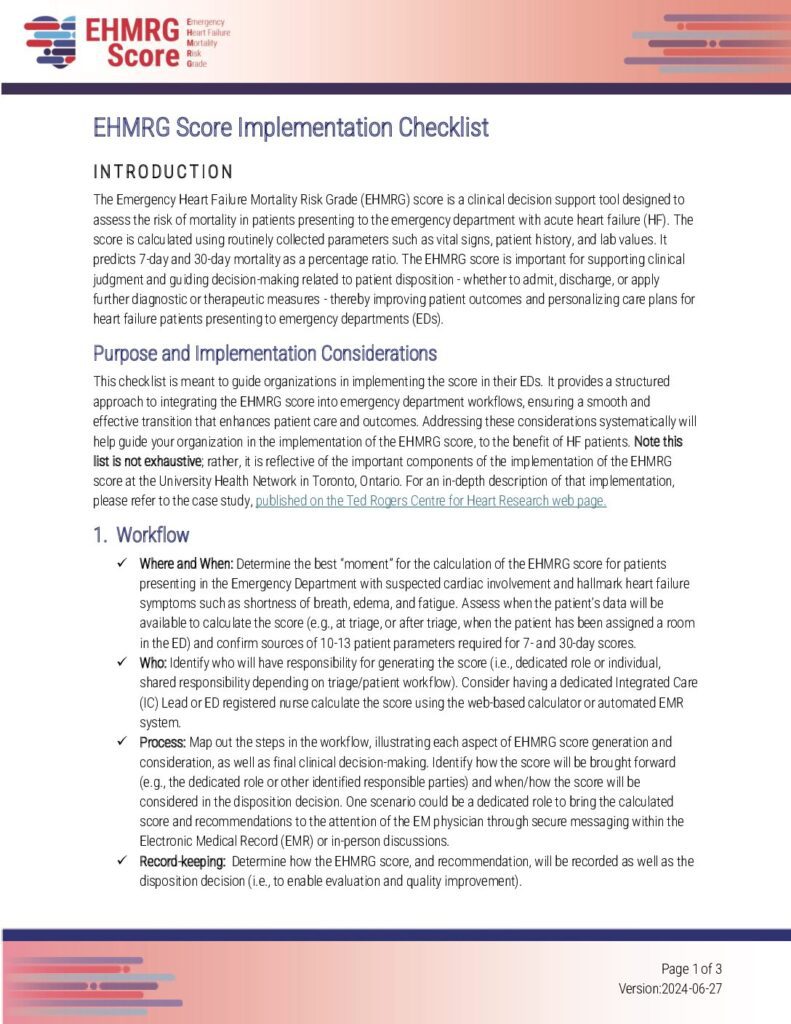
This checklist outlines key considerations and question prompts for institutions looking to implement the EHMRG score.
It provides an overview of everything required to successfully bring the EHMRG score into your emergency department, including:
- Workflow considerations
- Technical considerations
- Human resource considerations
- Education
- Communications
-
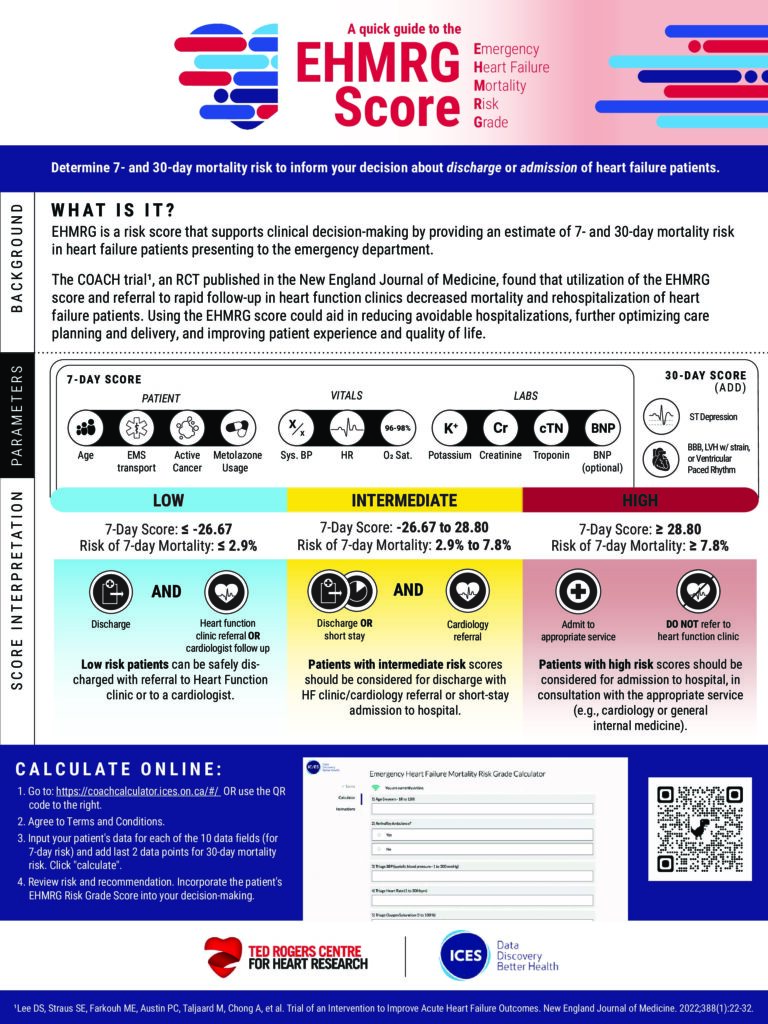
Download a quick guide to the EHMRG Score that can be used by clinicians in the emergency department. This infographic includes:
- Background information on the score
- Parameters needed to run the calculator
- Score interpretation guidelines
- Where and how to access the calculator
-
Listen to Drs. Douglas Lee and Claire Atzema discuss the challenges of heart failure in the ED and how the EHMRG score can help with Emergency Medicine (EM) Cases host Dr. Anton Helman.
-
The EHMRG score is featured in educational rounds at hospitals across Ontario, raising awareness of both the tool and heart failure patients presenting in the ED. It was featured in a CAEP National Grand Rounds in February 2025. Listen to the CME-accredited webinar, Managing Heart Failure in the Emergency Department: Understanding the EHMRG Score, now available online.
Partners & Acknowledgements
The EHMRG Calculator and corresponding resources would not have been possible without:
- Dr. Douglas Lee – Founder of the EHMRG score, Cardiologist at the Peter Munk Cardiac Centre, and Chair in Heart Function Outcomes at the Ted Rogers Centre for Heart Research
- Dr. Heather Ross – Head of the Division of Cardiology at UHN, Scientific Lead of Ted Rogers Centre for Heart Research at UHN
- Dr. Erin O’Connor – Director, Division of Emergency Medicine at UHN
Jesmilavathani Murusalin – Integrated Care Lead, Toronto General Hospital Emergency Department - Dr. Suzanna Mak – Cardiologist at Mount Sinai Hospital, Steering Committee Member for COACH Trial
- Dr. Michael J. Schull – Chief Executive Officer at ICES, Steering Committee Member for COACH Trial
- Dr. Michael E. Farkouh – Cardiologist at Mount Sinai Hospital, Steering Committee Member for COACH Trial
- Anne Simard – Staff Scientist, Ted Rogers Centre for Heart Research
- Dr. Sam Petrie – CIHR Health System Impact Fellow, Ted Rogers Centre for Heart Research
- Samantha Engbers – Research Planning Associate, Ted Rogers Centre for Heart Research
- Samantha Li – Animator and Medical Communicator
Funding
Funding was generously provided by the Ted Rogers Centre for Heart Research, Institute for Clinical Evaluative Sciences, and the Ontario SPOR SUPPORT Unit’s IMPACT award.