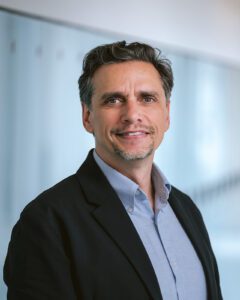
A middle-aged man with glasses wearing a grey blazer over a dark button-down shirt.

Michael Laflamme

MD, PhD

  • Robert R. McEwen Chair in Cardiac Regenerative Medicine, University Health Network
  • Canada Research Chair (Tier 1), Cardiovascular Regenerative Medicine
  • Senior Scientist, McEwen Stem Cell Institute, University Health Network

Research Focus Areas

  • Cardiac Electrophysiology
  • Cardiac Regeneration
  • Cell therapy
  • Stem Cell-Derived Cardiomyocytes

Overview

Michael Laflamme is the Robert McEwen Chair in Cardiac Regenerative Medicine, Canada Research Chair (Tier 1) in Cardiovascular Regenerative Medicine, Senior Scientist in the McEwen Stem Cell Institute at the University Health Network, and Professor of Laboratory Medicine & Pathobiology at the University of Toronto. His research program focuses on the development of novel cell-based therapies, with particular emphasis on human pluripotent stem cell-derived cardiomyocytes (hPSC-CMs) and electrophysiological issues related to their use.

His laboratory has made several important contributions, including the development of protocols to efficiently guide hPSCs into cardiomyocytes and specialized cardiac subtypes, early proof-of-concept transplantation studies in infarct models, and the first direct demonstration that hPSC-derived cardiac grafts can electrically integrate and activate synchronously with host tissue. His laboratory’s work also contributed to the scientific foundation for BlueRock Therapeutics, a regenerative medicine company launched in 2016.

Current research focuses on overcoming barriers to clinical translation, including scalable cell manufacturing and maturation, incomplete graft remuscularization, and host-graft electrophysiological integration.

Collaborators would find his stem cell and electrophysiology expertise particularly valuable for advancing cardiac cell therapies.

Published Research

Showing 4 out of 7 results

  • Bright Ferritin for Non-Invasive MRI Monitoring of the Fate of Transplanted hPSC-Cardiomyocytes in the Infarcted Rat Heart.

    2026 | Magnetic resonance in medicine

    Zhuang K, Alibhai FJ, Qiang B, Romagnuolo R, Vollett KDW, Freeman BKC, Gomez-Garcia MJ, Sadikov Valdman T, Ganesh T, Zhou YQ, Cheng HM, Laflamme MA, Cheng HM

  • Generation of Valvular Interstitial Cells from Human Pluripotent Stem Cells

    2025 |

    Amine Mazine, Alexander A. Mikryukov, Ian Fernandes, Clifford Z. Liu, Soheil Jahangiri, Marcy Martin, Eric K. N. Gähwiler, Melanie Generali, Juliana Gomez, Neda Latifi, Yifei Miao, Yu Liu, Michael A Laflamme, Craig A Simmons, Simon P. Hoerstrup, Maximilian Y. Emmert, Bruce D. Gelb, Mingxia Gu, Gordon M. Keller

  • Human pluripotent stem cell-based cardiac repair: Lessons learned and challenges ahead

    2025 | Advanced Drug Delivery Reviews

    E.Coulter Montague, Bilgehan Ozcan, Elana Sefton, Fanny Wulkan, Faisal J. Alibhai, Michael A. Laflamme

  • Single-cell transcriptome analysis reveals CD34 as a marker of human sinoatrial node pacemaker cardiomyocytes.

    2024 | Nature communications

    Amos A. Lim, Delaram Pouyabahar, Mishal Ashraf, Kate Huang, Michelle Lohbihler, Brandon M. Murareanu, Matthew L. Chang, Maggie Kwan, Faisal J. Alibhai, Thinh Tran, Amine Mazine, Michael A. Laflamme, Gary D. Bader, Zachary Laksman, Stephanie Protze

Research Laboratory

The Laflamme lab focuses on regenerating the injured heart using human pluripotent stem cell-derived cardiomyocytes (hPSC-CMs), addressing barriers that have historically limited the translation of this approach, including the immature phenotype of hPSC-CMs. The lab has developed scalable methods for manufacturing hPSC-CMs and shown that these cells can partially remuscularize the infarct scar, electrically integrate with the host myocardium, and mediate beneficial effects on contractile function across multiple preclinical myocardial infarction models. In the translationally relevant porcine MI model, the lab has shown that hPSC-CM transplantation results in large, centimetre-scale human myocardial implants that mature progressively over time. Current projects include developing scalable approaches to promote in vitro maturation of hPSC-CMs, creating tools to characterize the electrical behaviour of hPSC-derived cardiac grafts in vivo, exploring pharmacological and gene-engineering approaches to improve host-graft electromechanical integration, and testing the efficacy and safety of these approaches toward eventual clinical translation.
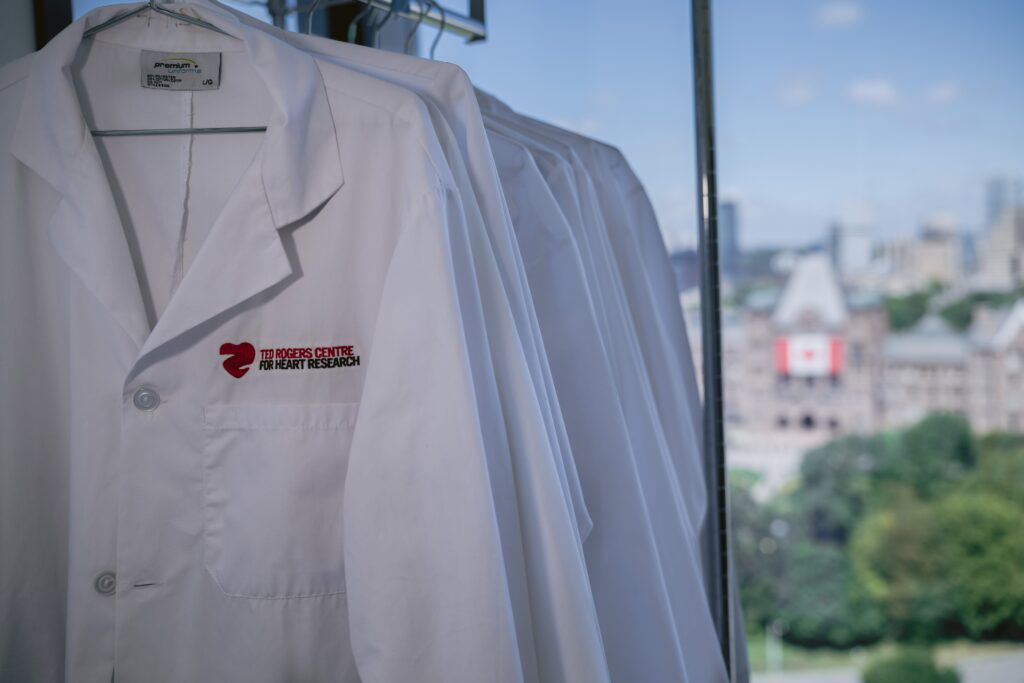
White lab coats with a Ted Rogers Centre for Heart Research logo hanging on a rack before a window overlooking the city, capturing life at the Ted Rogers Centre.