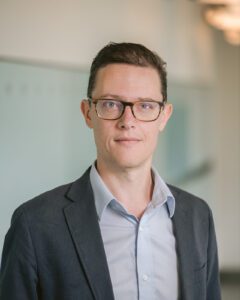
A man with short brown hair wearing glasses and a light-colored button-down shirt smiles at the camera.

Daniel Franklin

PhD

  • Ted Rogers Chair in Cardiovascular Engineering, Ted Rogers Centre for Heart Research
  • Assistant Professor, Institute of Biomedical Engineering, University of Toronto

Research Focus Areas

  • Biophotonics
  • Digital Health
  • Machine Learning
  • Wearable Hemodynamic Monitoring
  • Wireless Implants

Overview

Daniel Franklin is an Assistant Professor in the Institute of Biomedical Engineering at the University of Toronto and the Ted Rogers Chair in Cardiovascular Engineering at the Ted Rogers Centre for Heart Research. His research interests centre on wearable hemodynamic monitoring and wireless implants, developing devices for monitoring advanced vital signs.

His awards include the Baxter Young Investigator Award, the Displaying Futures Award from Merck KGaA, the Order of Pegasus at the University of Central Florida, and the Connaught New Researcher Award from the University of Toronto. He completed his PhD in Physics at the University of Central Florida and a postdoctoral fellowship at Northwestern University with Professor John Rogers, developing bioresorbable materials and flexible wireless electronics before joining the University of Toronto faculty in 2021.

He has said he was drawn to the Ted Rogers Centre by its close clinical collaborators at SickKids and UHN, whose day-to-day challenges managing heart failure patients inform which engineering problems his lab chooses to pursue. He collaborates closely with the Centre for Digital Therapeutics at UHN to connect wearable sensor data streams to digital self-care platforms for heart failure patients through the TRANSFORM HF partnership.

Collaborators would find his wireless and wearable sensor work particularly valuable for next-generation cardiac monitoring projects.

Published Research

Showing 2 out of 2 results

  • Multiwavelength Implantable Oximeter for Wireless Monitoring of Tissue Oxygenation in the Presence of Blood Volume Changes.

    2026 | Advanced healthcare materials

    Anat Usatinsky, Hugo L. Higueros‐Garcia, Sadi Loai, Samantha Unger, Jacob Trueb, Yonatan Usatinsky, Rawad Alkallas‐Valdiviezo, Noor Abu Jarad, Jonathan Wu, Hai‐Ling M. Cheng, John A. Rogers, Abraham Vázquez‐Guardado, Daniel Franklin

  • Incidence of Dementia and Subsequent Outcomes in Patients With Heart Failure

    2026 | JACC: Advances

    Paul Tieu, Raed A. Joundi, Finlay A. McAlister, Moira K. Kapral, Nadia Khan, Richard H. Swartz, Clare L. Atzema, Peter C. Austin, Philip A. Barber, Filio Billia, Steffen-Sebastian Bolz, Kim A. Connelly, Jafna L. Cox, Catherine Demers, Simon Duchesne, Thalia S. Field, Jason E. Fish, John S. Floras, Daniel Franklin, Andrew C.T. Ha, Kate Hanneman, Tomi Odugbemi, Kieran L. Quinn, Frank Rudzicz, Anne Simard, Amit Singnurkar, Eric E. Smith, Sharon E. Straus, Rima Styra, Louise Y. Sun, Monica Taljaard, Joann Varickanickal, Amol Verma, Xuesong Wang, Andrew T. Yan, Shelley Zieroth, Michael D. Hill, Heather J. Ross, Gustavo Saposnik, Douglas S. Lee

Research Laboratory

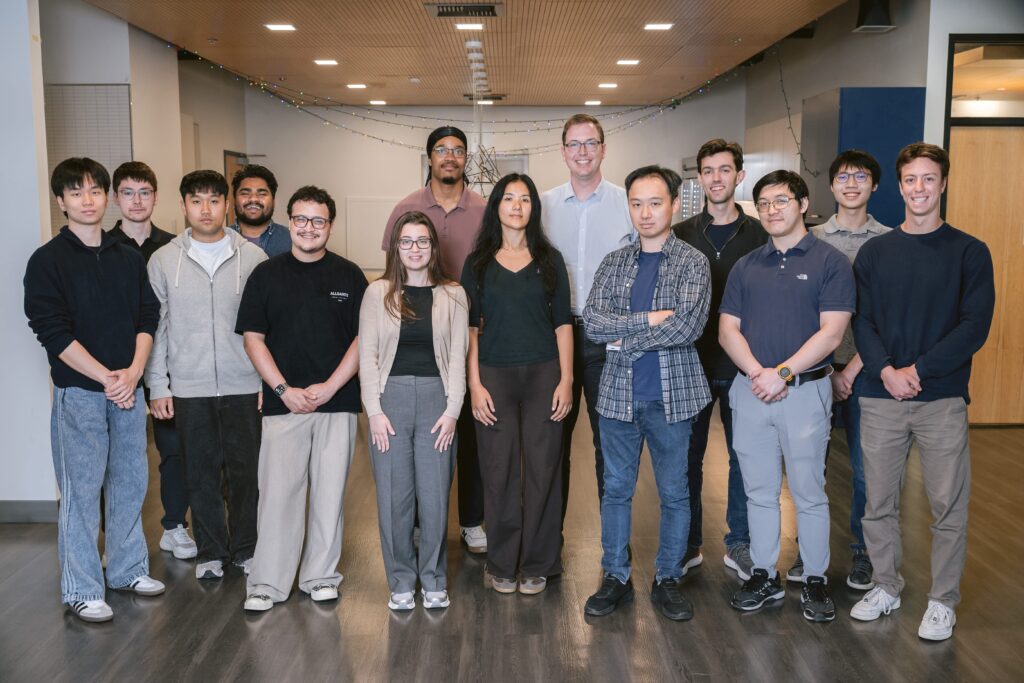
The Franklin Research Lab uses branches of optics, engineering, and biology to produce medical technologies for clinical translation, including wearable hemodynamic monitoring devices for advanced vital signs and wireless implants for physiological monitoring and closed-loop feedback. This work builds directly on Franklin’s postdoctoral training with John Rogers at Northwestern University, where he helped develop bioresorbable materials, laser systems, and flexible wireless implants and wearables for hemodynamic monitoring, technology his own lab now adapts specifically toward heart failure applications. The lab partners with industry-leading semiconductor and health technology companies to develop and commercialize new sensor technologies.