

Headshot of Scott Heximer, researcher at the Ted Rogers Centre for Heart Research.

Scott P. Heximer

PhD

Chair, Department of Physiology, University of Toronto

Research Focus Areas

  • Heterotrimeric G-protein Signalling

Overview

Scott Heximer is Chair of the Department of Physiology at the University of Toronto. His research interests center on G-protein signaling, cardiac fibrosis, and hypertension, investigating the roles of heterotrimeric G-protein signaling in cardiovascular physiology.

Among his most significant scientific contributions, he was part of the research team that discovered the G-protein signaling regulator RGS2 and has built his career around characterizing its role in cardiovascular physiology, showing that mice lacking RGS2 develop a strong hypertensive phenotype and that these signaling pathways are important in hypertension, asthma, atrial fibrillation, and heart failure.

He has published more than 55 peer-reviewed papers, including in the Proceedings of the National Academy of Sciences and the Journal of Clinical Investigation, with over 2,600 cumulative citations. He has served as President of the Canadian Society of Atherosclerosis, Thrombosis and Vascular Biology, chairing the organizing committee for its 2018 International Symposium of Atherosclerosis, and received the Canadian Hypertension Society New Investigator Award earlier in his career, alongside American Heart Association and Lucille P. Markey postdoctoral fellowships.

He collaborates with fellow physiologist Anthony Gramolini within the Translational Biology and Engineering Program (TBEP). His current work aims to characterize the diverse roles of cardiac fibroblasts in the repair and pathogenesis of injured hearts. Collaborators would find his cardiac fibroblast work particularly valuable for projects on fibrosis in the injured heart.

Published Research

Showing 2 out of 2 results

  • Latent Transforming Growth Factor Binding Protein ? 2 promotes microfibrillar TGF-? bioavailability to drive pathologic fibrosis in remote regions of infarcted hearts

    2026 |

    Fahad Ehsan, Michelle Di Paola, Micael Dewar, Hangjun Zhang, Uros Kuzmanov, Yu-Qing Zhou, Cristine J Reitz, Haisam Shah, Tao Wang, Jingzhi Liu, Aliya Izumi, Rundong Hu, Joanna Hendy, Fareshteh Sadat Younesi, Mark K. Friedberg, Filio Billia, Tomoyuki Nakamura, Boris Hinz, Robert P Mecham, Anthony O Gramolini, Scott P Heximer

  • Endothelial dysfunction drives atherosclerotic plaque macrophage-dependent abdominal aortic aneurysm formation.

    2025 | Nature immunology

    Danya Thayaparan, Takuo Emoto, Aniqa B. Khan, Rickvinder Besla, Homaira Hamidzada, Mahmoud El-Maklizi, Tharini Sivasubramaniyam, Shabana Vohra, Ash Hagerman, Sara Nejat, Charlotte E. Needham-Robbins, Tao Wang, Moritz Lindquist, Steven R. Botts, Stephanie A. Schroer, Masayuki Taniguchi, Taishi Inoue, Katsuhiro Yamanaka, Haotian Cui, Edouard Al-Chami, Hangjun Zhang, Marwan G. Althagafi, Aja Michalski, Joshua J. C. McGrath, Steven P. Cass, David Luong, Yuya Suzuki, Angela Li, Amina Abow, Rachel Heo, Shaun Pacheco, Emily Chen, Felix Chiu, John Byrne, Tomoyuki Furuyashiki, Mansoor Husain, Peter Libby, Kenji Okada, Kathryn L. Howe, Scott P. Heximer, Tomoya Yamashita, Bo Wang, Barry B. Rubin, Myron I. Cybulsky, Joy Roy, Jesse W. Williams, Sarah Q. Crome, Slava Epelman, Ken-ichi Hirata, Martin R. Stampfli, Clinton S. Robbins

Research Laboratory

The Heximer lab studies cardiac signaling in normal and diseased states across the different cell types of the heart, focusing on how altered heterotrimeric G-protein signaling affects cardiac function and how different subpopulations of cardiac-resident cells contribute to fibrosis and arrhythmogenesis. The lab’s foundational discovery involves RGS2, a regulator of G-protein signaling that the group helped identify and has since built an entire research program around: mice lacking RGS2 develop a strong hypertensive phenotype along with prolonged vasoconstrictor responses, demonstrating that precise kinetic control of G-protein-coupled receptor signaling is essential for normal blood pressure regulation. Building on this foundation, the lab has extended its work to show that altered G-protein signaling pathways are important in hypertension, asthma, atrial fibrillation, and heart failure, connecting a single molecular mechanism to several seemingly unrelated cardiovascular and respiratory conditions. The current focus of the lab is to characterize distinct populations of cardiac-resident cells – including fibroblasts, sinoatrial myocytes, and atrial myocytes – that each contribute differently to fibrosis and arrhythmia development. The lab collaborates with fellow physiologist Anthony Gramolini on related cardiac signaling questions within the Translational Biology and Engineering Program at the Ted Rogers Centre.
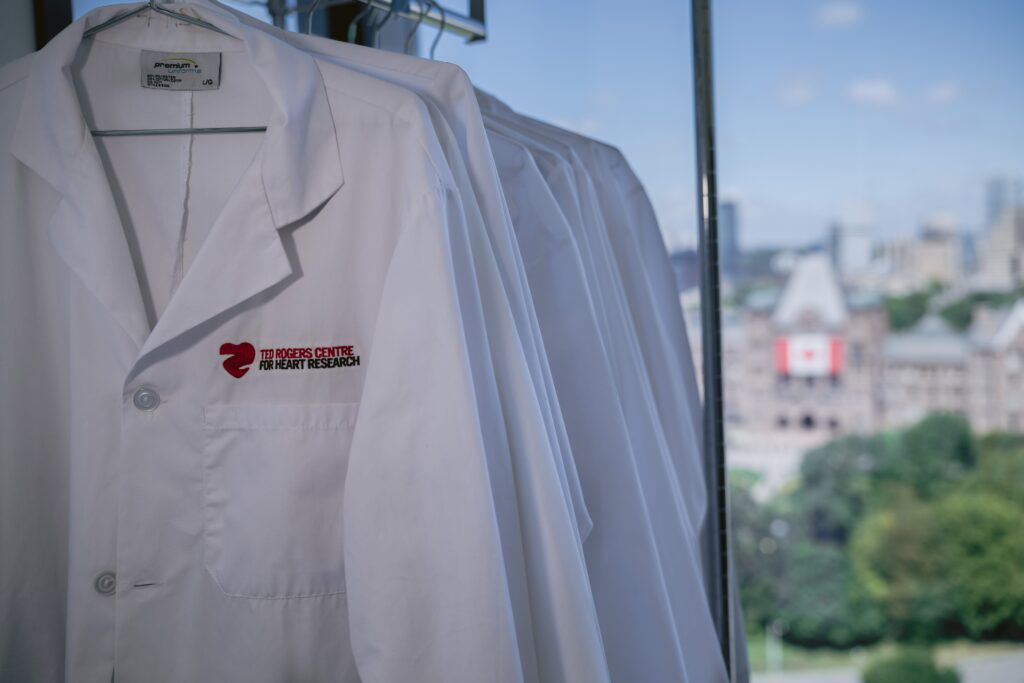

White lab coats with a Ted Rogers Centre for Heart Research logo hanging on a rack before a window overlooking the city, capturing life at the Ted Rogers Centre.