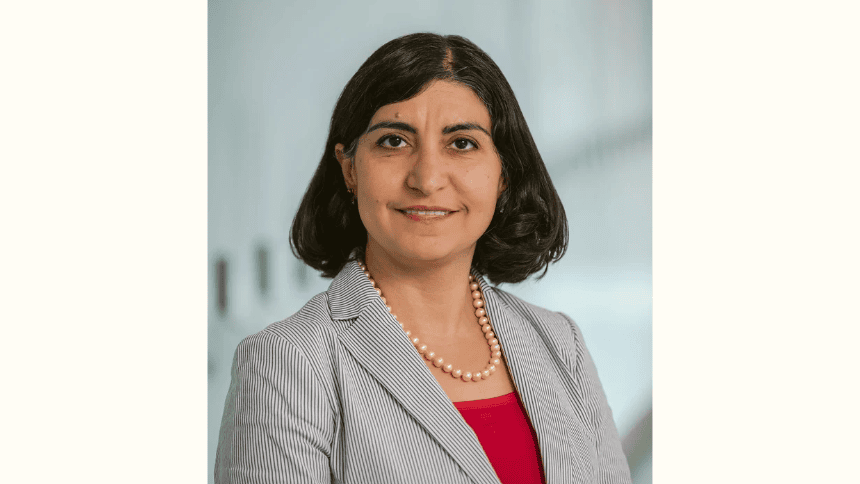
Welcoming Professor Azadeh Yadollahi as Scientific Director of TBEP
How fluid moves through the body overnight can change the mechanics of breathing. Research led by Professor Azadeh Yadollahi has helped show how fluid shifting from the legs toward the chest and neck narrows the upper airway and contributes to obstructive sleep apnea, a particular concern for people living with heart failure. Her interdisciplinary program connects that mechanistic understanding with voice-based biomarkers, physiology-informed artificial intelligence and intelligent textiles, with the goal of making cardiorespiratory assessment more accurate, accessible and useful beyond specialized laboratories.
On July 1, 2026, Dr. Yadollahi began a five-year appointment as Scientific Director of the Translational Biology and Engineering Program (TBEP), joining the executive committee of the Ted Rogers Centre for Heart Research (TRCHR). We are delighted to welcome her to this role.
TBEP, the University of Toronto arm of TRCHR, brings together engineering, medicine and the biological sciences to understand cardiovascular disease, advance early diagnostics and develop new therapeutic and regenerative approaches. Its strength lies in investigator-led science and a collaborative ecosystem linking the University of Toronto, University Health Network and The Hospital for Sick Children (SickKids).
Dr. Yadollahi joined the University of Toronto in 2015 as an Assistant Professor (Affiliated Scientist) in the Institute of Biomedical Engineering and became an Associate Professor in 2021. She is a Senior Scientist at KITE-Toronto Rehabilitation Institute, University Health Network, and holds a Canada Research Chair (Tier II) in Cardiorespiratory Engineering. Her research has generated granted patents, licensed technologies and FDA-cleared devices; through the FIBRE research platform, she has also helped bring together more than 115 academic, clinical, industry and community partners.
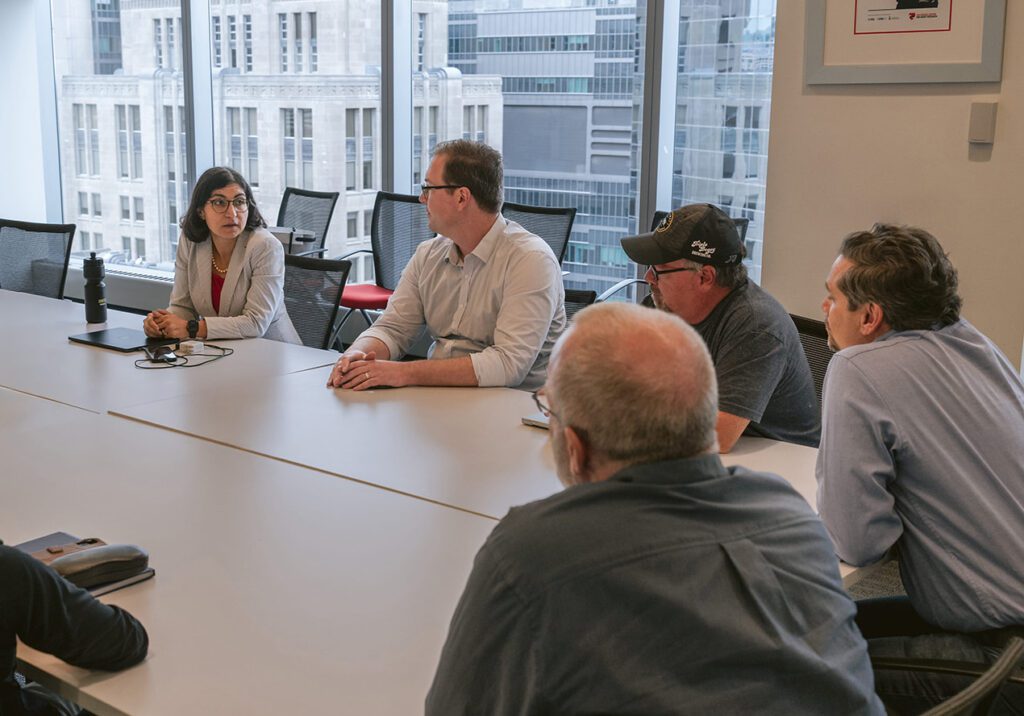
We spoke with Dr. Yadollahi about the science that drives her, her vision for TBEP and the values that shape her leadership.
On her previous work
What drew you to the connection between sleep, breathing, and heart health, and how did it lead you toward heart failure research specifically?
“I came to this work through a physiological question: how do changes in hemodynamics and fluid distribution during sleep affect the airway? Our studies have shown that fluid shifting upward from the legs can narrow the pharynx and contribute to obstructive sleep apnea. We have also examined how fluid accumulation in the chest, breathing mechanics and autonomic control contribute to cardiorespiratory instability. This is particularly relevant for people with heart failure, in whom fluid overload and sleep-disordered breathing are common and interplay in a vicious cycle.
Understanding these mechanisms led to another question: how can we assess them accurately throughout the night, from one night to the next, and beyond specialized sleep laboratories? That challenge motivated my team to develop bioimpedance methods, wearable sensing and physiology-informed approaches to monitoring. The Ted Rogers Centre has been an important part of this journey through innovation funding, trainee support and collaborations such as TRANSFORM HF and CaRDM Eq, which share our commitment to more accessible and equitable heart care.”
What’s a project or finding from your career so far that you’re especially proud of?
“I am especially proud of the work where scientific excellence and accessibility come together. We have worked with people experiencing homelessness to improve access to sleep care, and we are developing voice-based biomarkers that may help assess sleep apnea risk and physiological traits using brief speech recordings. Our smart-textile research is also exploring how validated physiological monitoring can become part of everyday life, including for people who cannot readily access conventional care in hospitals.
What unites these projects is co-design. We involve patients, family members, clinicians and community partners from the beginning to understand what matters to them and what makes a technology practical, trustworthy and useful. For me, accessibility is not something we add after a technology is developed; it is part of how we define the research question and evaluate success.”
On her vision for TBEP
TBEP was built around the idea of collaboration. What does that mean to you as you step into this role?
“TBEP’s collaborative culture is one of the main reasons I accepted this role. The program brings together outstanding scientists working across disease mechanisms, cardiovascular biology, regenerative medicine, imaging, biomaterials and engineering. Just as important, it has a collegial community, shared spaces and a genuine commitment to team science.
I see my role as protecting that foundation while creating new opportunities for investigators to connect their expertise, pursue ambitious questions and advance excellent discovery-driven research. My vision builds on the belief that TBEP is far more than the sum of its people. Together, and with our partners across the Ted Rogers Centre, we can move important discoveries toward better heart care faster and more equitably.”
What excites you most about starting this new role?
“What excites me most is the opportunity to build on TBEP’s scientific excellence and help shape its next chapter. Advances in regenerative science, AI-enabled discovery, early detection and prevention are opening important questions that no single discipline can answer. By connecting our strengths in fundamental biology, engineering and clinical research, we can ask new questions, test bold ideas and create pathways to meaningful impact.
I do not want TBEP simply to adapt to the changes transforming cardiovascular research and care. I want us, together, to help define that change.”
What are your priorities for the first year, and what do you hope TBEP will achieve over the next five years?
“First, I want to listen deeply, to investigators, trainees, staff and partners, to understand their aspirations, the areas of excellence we should build on and the barriers we can remove together. From there, we can align around two or three high-impact, investigator-led initiatives and build the partnerships, shared infrastructure and major funding opportunities needed to support them.
Over the next five years, I want to build on TBEP’s exceptional foundation to create lasting scientific capacity and enable even more ambitious, collaborative research. My goal is to strengthen the environment where our investigators and trainees can thrive, pursue bold ideas, and translate discoveries into meaningful advances in heart health. I envision TBEP becoming a global partner of choice for translational cardiovascular innovation. We should not simply adapt to changes in science and care; together, we should help define them. Ultimately, our success will be measured by the excellence of our science and its lasting impact on patients and communities.”
Getting to know Azadeh
What’s a piece of advice that stuck with you since your training days?
“Follow the questions you genuinely care about. Research is difficult, and that sense of purpose helps you persist. I also encourage trainees to take on challenges before they feel completely ready: confidence and expertise grow through preparation, practice, feedback and collaboration. Stay curious, persevere, and remember the people your research is meant to serve.”
Outside the lab, what’s something people might be surprised to learn about you?
“I love gardening. I grow flowers, vegetables, fruit trees and, more recently, herbs for tea. Gardening has taught me a great deal about leadership: you cannot make a plant grow, but you can create the conditions in which it will thrive. I try to do the same for people, recognize their strengths, provide support and give them room to grow.”
If you could have coffee with one person, living or historical, who would it be and why?
“My four nieces and nephews in Iran. I have not seen them in eight years, and I have never met three of them in person. More than coffee, I would love to sit down with them for a tea party. I remain hopeful that we will be together soon.”
Welcome, Azadeh
We thank Professor Craig Simmons for more than a decade of leadership that helped make TBEP the outstanding scientific and collaborative community it is today. Please join us in welcoming Professor Azadeh Yadollahi as she builds on that legacy with TBEP’s investigators, trainees, staff and partners, and helps lead the next chapter of translational cardiovascular research at the Ted Rogers Centre.