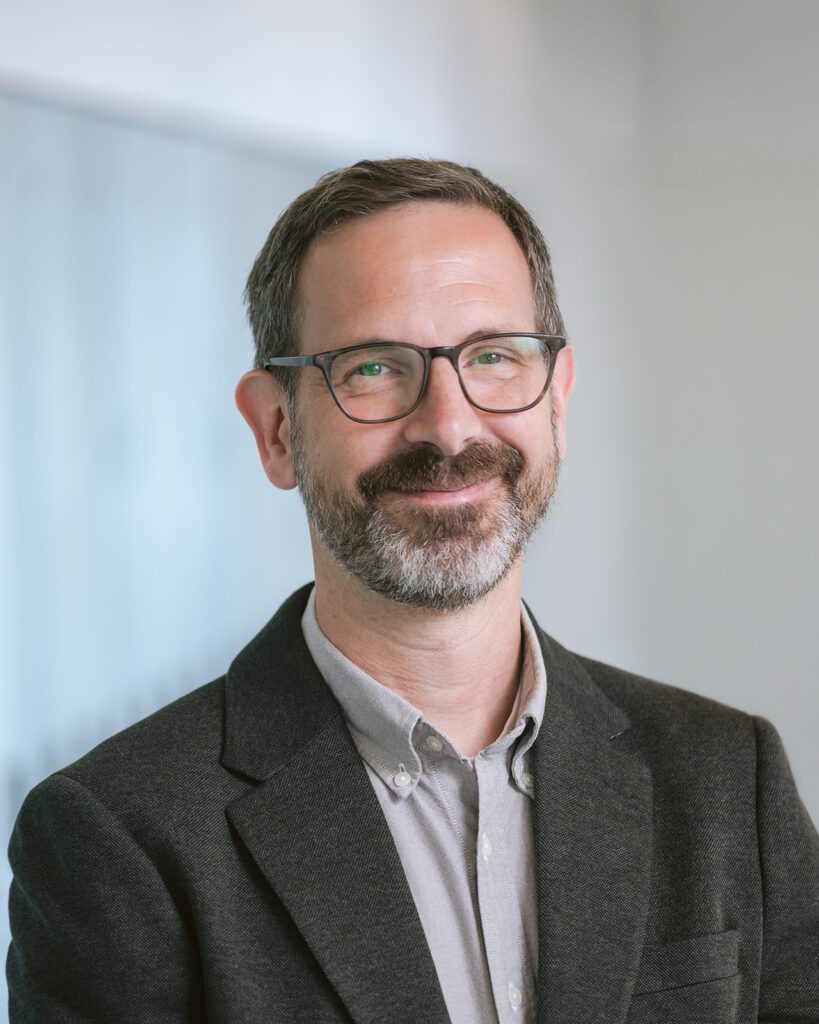
Headshot of Jason Fish, researcher at the Ted Rogers Centre for Heart Research.

Jason Fish

PhD

  • Senior Scientist, Peter Munk Cardiac Centre, University Health Network Research Institutes
  • Professor, Laboratory Medicine and Pathobiology, University of Toronto

Research Focus Areas

  • Cell-cell communication
  • Inflammation
  • Transcriptional and Post-Transcriptional Regulation
  • Translational Disease models
  • Vascular Biology

Overview

Jason Fish is a Senior Scientist at the Peter Munk Cardiac Centre, University Health Network Research Institutes, and a Professor in the Department of Laboratory Medicine and Pathobiology at the University of Toronto. His research interests centre on vascular biology, endothelial cell function, and gene regulation (transcription and non-coding RNA), and he investigates the molecular mechanisms that govern endothelial cell behaviour and communication across vascular and cardiometabolic diseases.

Among his most significant discoveries, his lab identified that somatic KRAS mutations within the endothelium are the primary cause of sporadic brain arteriovenous malformations, a leading cause of stroke in young people, work that has opened up new approaches for treatment. He received the CIHR/CSATVB Mid-Career Excellence Award in Blood and Blood Vessel Research and is a past president of the North American Vascular Biology Organization, having previously held a Tier 2 Canada Research Chair in Vascular Cell and Molecular Biology from 2013 to 2023. He completed his PhD at the University of Toronto under Philip Marsden and a postdoctoral fellowship with Deepak Srivastava at the Gladstone Institute of Cardiovascular Disease and UCSF. His expertise in brain vasculature also provides insight into how cardiovascular disease affects cognitive function.

Collaborators would find his vascular biology and translational models particularly valuable for atherosclerosis and chemotherapy-related vascular toxicity projects.

Published Research

Showing 4 out of 34 results

  • In vitro multi-organ invasion model for exploring cardiac resistance to cancer metastasis.

    2026 | Nature communications

    Amid Shakeri, Dhana Abdo, Matthew Ho Cheong Lei, Sargol Okhovatian, Garrett F. Beeghly, Anna Maria Popovic, Richard Jiang, Chuan Liu, Karl T. Wagner, Daniel Vosoughi, Jennifer Kieda, Jason E. Fish, Milica Radisic

  • ERG preserves endothelial identity to limit atherosclerosis.

    2026 | Nature communications

    Steven R. Botts, Corey A. Scipione, Kristen Schulz, Leandro C. D. Breda, Kai Ellis, Christy Ho, Sneha Raju, Kamalben Prajapati, Kai Yu, Aniqa B. Khan, Chanele K. Polenz, Stylianos Z. Prattas, Sharon J. Hyduk, Christian Cao, Joshua D. Wythe, Clint S. Robbins, Clint L. Miller, Myron I. Cybulsky, Jason E. Fish, Kathryn L. Howe

  • c-KIT expands the tool kit for treating arteriovenous malformation

    2026 | Journal of Clinical Investigation

    Ruilin Wu, Jason E. Fish

  • Incidence of Dementia and Subsequent Outcomes in Patients With Heart Failure

    2026 | JACC: Advances

    Paul Tieu, Raed A. Joundi, Finlay A. McAlister, Moira K. Kapral, Nadia Khan, Richard H. Swartz, Clare L. Atzema, Peter C. Austin, Philip A. Barber, Filio Billia, Steffen-Sebastian Bolz, Kim A. Connelly, Jafna L. Cox, Catherine Demers, Simon Duchesne, Thalia S. Field, Jason E. Fish, John S. Floras, Daniel Franklin, Andrew C.T. Ha, Kate Hanneman, Tomi Odugbemi, Kieran L. Quinn, Frank Rudzicz, Anne Simard, Amit Singnurkar, Eric E. Smith, Sharon E. Straus, Rima Styra, Louise Y. Sun, Monica Taljaard, Joann Varickanickal, Amol Verma, Xuesong Wang, Andrew T. Yan, Shelley Zieroth, Michael D. Hill, Heather J. Ross, Gustavo Saposnik, Douglas S. Lee

Research Laboratory

The Fish Lab investigates the molecular mechanisms that govern endothelial cell biology across a spectrum of vascular and cardiometabolic diseases, treating endothelial cells as dynamic integrators of their microenvironment that translate physiological and pathological cues into coordinated biological responses. The lab discovered that somatic KRAS mutations within the endothelium are the primary cause of sporadic brain arteriovenous malformations (bAVMs), a leading cause of stroke in young people, and has built preclinical models of bAVM using patient-derived samples, organoid systems, and high-throughput screening platforms to identify and test novel therapeutic strategies. The lab also examines how systemic inflammation and endothelial activation contribute to atherosclerosis, and how chemotherapy affects the vascular system, including work on circulating vascular biomarkers that predict cancer therapy-related cardiac dysfunction. The lab uses a multidisciplinary and translational approach integrating zebrafish and mouse models, cultured human endothelial cells, patient-derived organoid systems, and analysis of human clinical specimens, and is known as a vibrant training environment for graduate students and postdoctoral fellows.
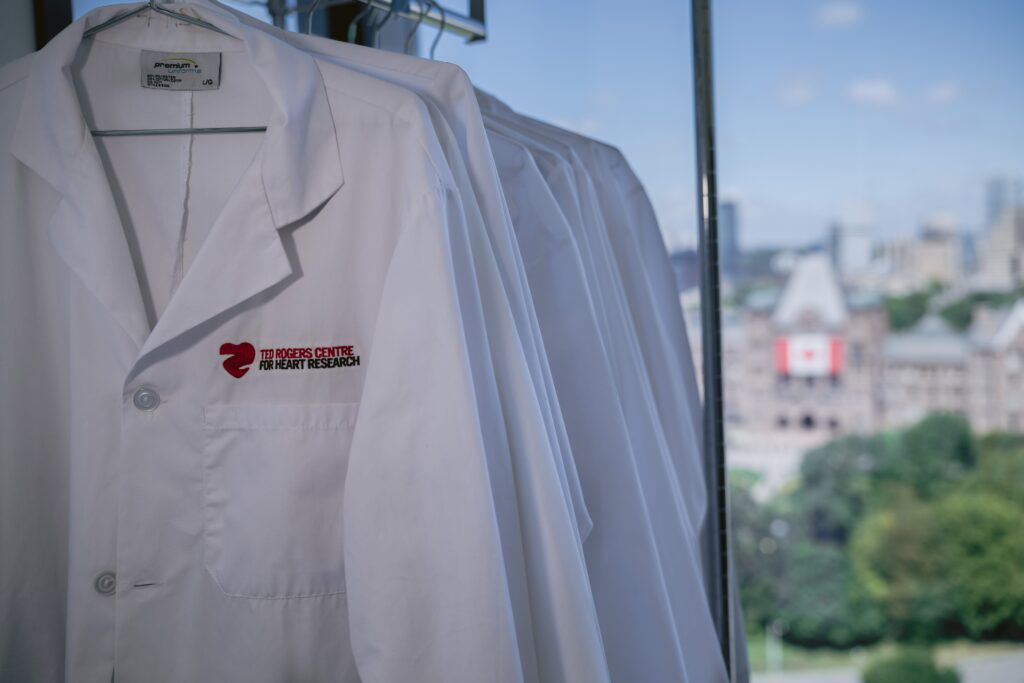
White lab coats with a Ted Rogers Centre for Heart Research logo hanging on a rack before a window overlooking the city, capturing life at the Ted Rogers Centre.