
A middle-aged man with a beard, wearing a grey suit, light blue dress shirt, and a patterned tie.

Jason T. Maynes

PhD/MD

  • Chief, Anesthesia and Pain Medicine, Hospital for Sick Children
  • Associate Chief of Research, Perioperative Services, Hospital for Sick Children
  • Professor, Anesthesiology and Pain Medicine, and Biochemistry, University of Toronto

Research Focus Areas

  • Biophysics
  • Disease Modeling
  • Drug Design
  • Protein structure and function
  • Regenerative Medicine

Overview

Jason T. Maynes is the Chief of Anesthesia and Pain Medicine and the Associate Chief of Perioperative Services (Research) at the Hospital for Sick Children. He is the holder of the Curtis Joseph and Harold Groves Chair in Anesthesia and Pain Medicine. He completed his graduate degree in Biophysics with doctoral and postdoctoral training at the University of Alberta, the University of California, Berkeley, Los Alamos National Laboratory, and Washington University in St. Louis. He completed his clinical training at the University of Alberta, Stanford University, and Washington University in St. Louis, and moved from St. Louis to Toronto in 2012.

His research primarily involves finding new ways to quantify drug action, both therapeutic and toxic, including how to improve the clinical effect of anesthetics and pain medications. His lab models cardiac function using stem cell-derived tissue, has developed new therapies for heart failure, and has created platform technologies that measure cardiomyocyte function for the purposes of drug discovery. He holds patents and intellectual property related to new therapies for heart failure, novel methods for quantifying cardiomyocyte function, and antiviral small-molecule therapies.

His lab is currently funded by CIHR, NSERC, the Canada Foundation for Innovation, the Ontario Research Fund, and the Labatt Family Heart Centre, in addition to funding from pharmaceutical and venture capital groups. He is on the scientific boards of the Society for Pediatric Anesthesia and the Society of Cardiovascular Anesthesiologists, and is a member of the CIHR College of Reviewers.

Collaborators would find his cardiomyocyte function platforms particularly valuable for cardiac drug screening projects.

Published Research

Showing 4 out of 17 results

  • Nanoparticles for the Delivery of Pro-regenerative Cardiac Progenitor Secretory Proteins Targeting Cellular Senescence and Vasculogenesis

    2025 | ACS Applied Bio Materials

    Shirley Chung, Zach Gouveia, Suja Shrestha, John G. Coles, Jason T. Maynes, J. Paul Santerre

  • Robotic manipulation of cardiomyocytes to identify gap junction modifiers for arrhythmogenic cardiomyopathy.

    2024 | Science robotics

    Wenkun Dou, Guanqiao Shan, Qili Zhao, Manpreet Malhi, Aojun Jiang, Zhuoran Zhang, Andrés González-Guerra, Shaojie Fu, Junhui Law, Robert M. Hamilton, Juan A. Bernal, Xinyu Liu, Yu Sun, Jason T. Maynes

  • Autosomal-dominant macular dystrophy linked to a chromosome 17 tandem duplication

    2024 | JCI Insight

    Rabiat Adele, Rowaida Hussein, Erika Tavares, Kashif Ahmed, Matteo Di Scipio, Jason Charish, Minggao Liang, Simon Monis, Anupreet Tumber, Xiaoyan Chen, Tara A. Paton, Nicole M. Roslin, Christabel Eileen, Evgueni Ivakine, Nishanth E. Sunny, Michael D. Wilson, Eric Campos, Raju V.S. Rajala, Jason T. Maynes, Philippe P. Monnier, Andrew D. Paterson, Elise Héon, Ajoy Vincent

  • Biomarkers of mitochondrial stress and DNA damage during pediatric catheter-directed neuroangiography – a prospective single-center study

    2024 | Pediatric Radiology

    Kaley A. Hogarth, Nicholas A. Shkumat, Simal Goman, Afsaneh Amirabadi, Suzanne Bickford, Prakash Muthusami, Bairbre L. Connolly, Jason T. Maynes

Research Laboratory

The Maynes laboratory aims to accelerate the discovery and development of novel therapeutic targets for cardiovascular disease by integrating protein biochemistry, structural biology, biophysics, and advanced human disease modeling. Their research focuses on understanding how protein structure, molecular interactions, and cellular signaling pathways regulate cardiac function, fibrosis, and regeneration. Through detailed characterization of disease-associated proteins and their molecular mechanisms, they seek to identify previously unrecognized therapeutic targets and develop innovative pharmacological strategies, including the rational design and optimization of small-molecule therapeutics.

A central component of their research is the development of innovative human cardiac disease-modeling platforms to enable therapeutic target discovery, mechanistic validation, and drug screening. Using induced pluripotent stem cell-derived cardiomyocytes, engineered three-dimensional cardiac tissues, and heart-on-a-chip technologies, they create physiologically relevant models of cardiac dysfunction and disease. By integrating advanced biosensors, robotics, and computational approaches, these platforms enable comprehensive characterization of cardiac physiology and pharmacological responses, facilitating the identification and validation of novel therapeutic interventions. Through multidisciplinary academic and industry collaborations, their overarching goal is to translate fundamental discoveries in protein function and disease mechanisms into targeted therapies that improve outcomes for patients with cardiovascular disease.
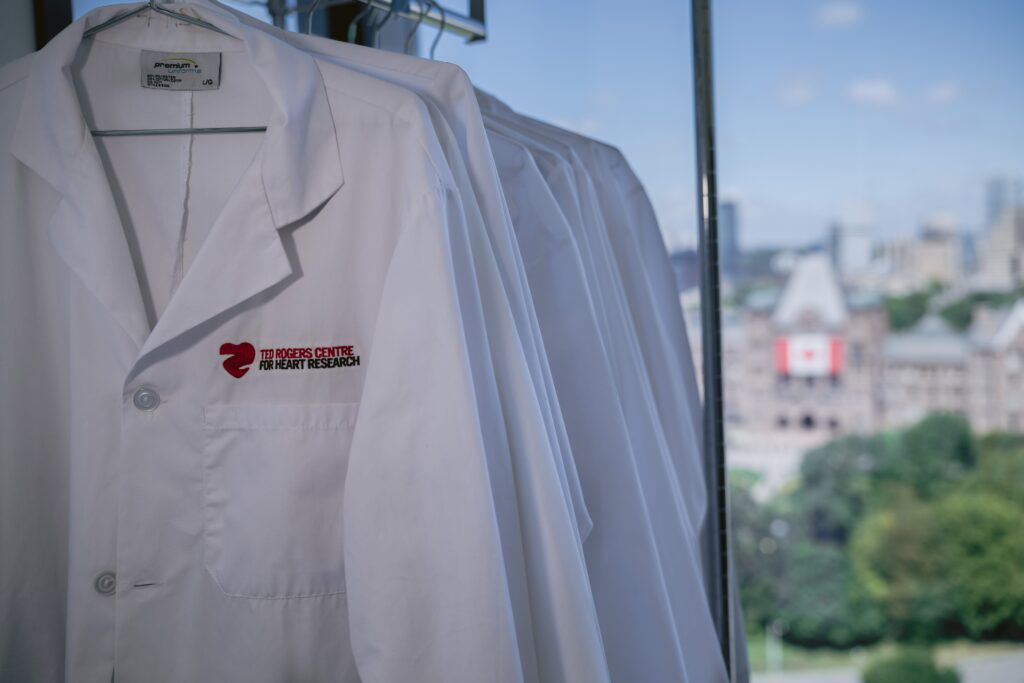
White lab coats with a Ted Rogers Centre for Heart Research logo hanging on a rack before a window overlooking the city, capturing life at the Ted Rogers Centre.