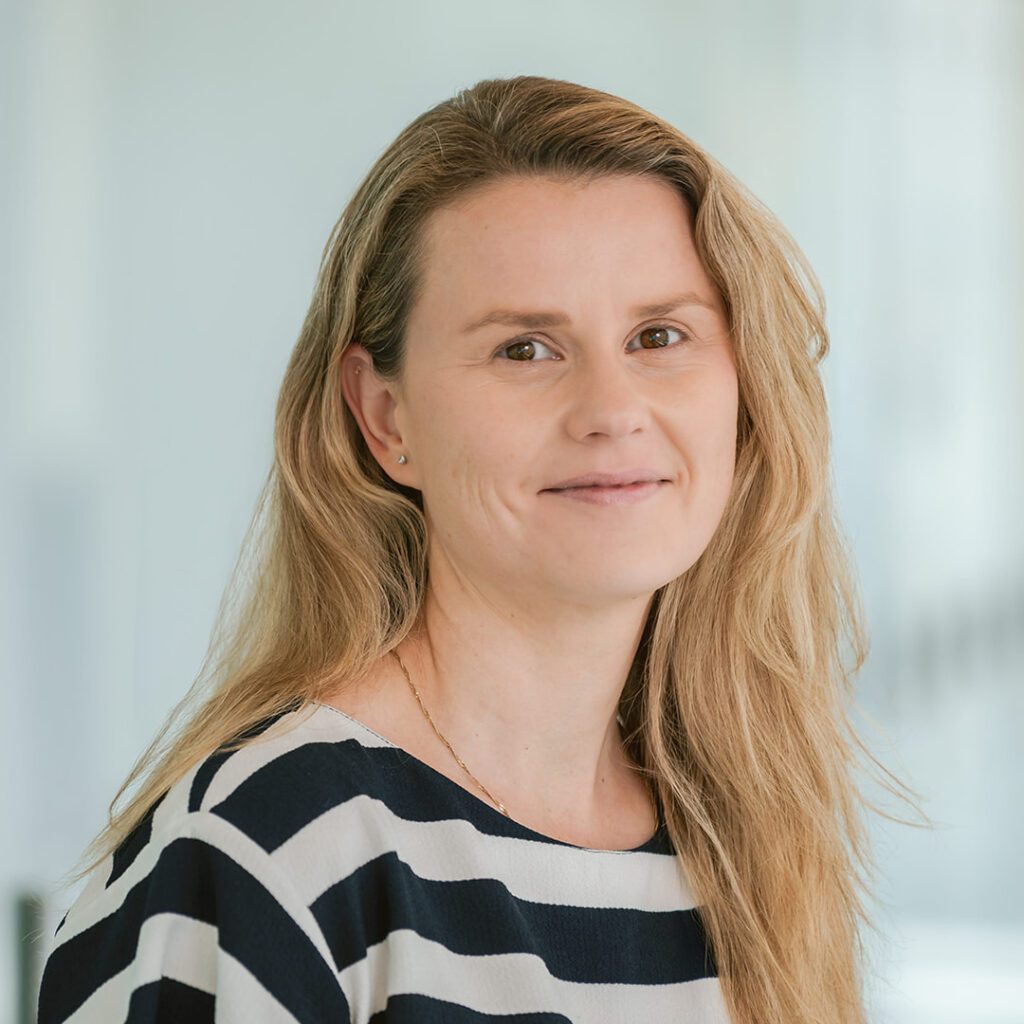
A woman with long blonde hair wearing a navy and white striped shirt.

Stephanie Protze

PhD

  • Senior Scientist, McEwen Stem Cell Institute, University Health Network
  • Assistant Professor, Department of Molecular Genetics, University of Toronto

Research Focus Areas

  • Biological Pacemaker
  • Cardiac Development
  • Cardiac Electrophysiology
  • Disease Modeling
  • Stem Cell Differentiation

Overview

Stephanie Protze is a Senior Scientist at the McEwen Stem Cell Institute, University Health Network, and an Assistant Professor in the Department of Molecular Genetics at the University of Toronto. Her research interests center on cardiac development, stem cell differentiation, cardiac electrophysiology, and disease modeling, studying human heart development and disease with the goal of developing new cardiovascular therapies.

She completed her BSc in Molecular Biotechnology at the Dresden University of Technology in 2007, then joined the International Max Planck Research School, earning her PhD in Cell Biology and Biomedicine from the University of Dresden in 2012 under Ursula Ravens and Elly Tanaka. She completed her postdoctoral fellowship in Gordon Keller’s laboratory at the McEwen Centre for Regenerative Medicine, UHN, before joining UHN as a Scientist and launching her independent research group in August 2018.

Her lab employs a range of experimental approaches spanning cell biology, molecular genetics, genomics, and electrophysiology to understand how the heart’s distinct cell types form during development and to apply this knowledge to disease modelling and cardiac cell therapies.

Collaborators would find her expertise with stem cell-derived human cardiac models particularly valuable for projects studying congenital heart defects or arrhythmia syndromes.

Published Research

Showing 4 out of 15 results

  • Patching up the heart: Electroconductive cardiac repair

    2026 | Cell Stem Cell

    Brandon M. Murareanu, Stephanie Protze

  • Recellularized Humanized Bioengineered Biatrial Model for Arrhythmia, Biological Pacemakers, and Optogenetic Studies.

    2026 | Circulation research

    Matteo Ghiringhelli, Daniel Shiff, Harel Grinstein, Tahel Kerem, Amit Gruber, Oded Edri, Michal Landesberg, Gil Arbel, Assad Shiti, Yehuda Wexler, Shany Glatstein, Maggie Kwan, Irit Huber, Stephanie Protze, Lior Gepstein

  • Human pluripotent stem cell-derived atrioventricular node-like pacemaker cells exhibit biological conduction bridge properties

    2026 | Cell Stem Cell

    Michelle Lohbihler, Amos A. Lim, Stéphane Massé, Brandon M. Murareanu, Maggie Kwan, Omar Mourad, Olya Mastikhina, Malak Elbatarny, Renu Sarao, Beiping Qiang, Wahiba Dhahri, Matthew L. Chang, Alice L.Y. Xu, Kasinan Suthiwanich, Merrilyn Chen, Amine Mazine, Shahryar Khattak, Sara S. Nunes, Kumaraswamy Nanthakumar, Michael A. Laflamme, Stephanie Protze

  • Genetic suppression features ABHD18 as a Barth syndrome therapeutic target.

    2025 | Nature

    Sanna N. Masud, Anchal Srivastava, Patricia Mero, Victoria Saba Echezarreta, Eve Anderson, Lennard van Buren, Jiarun Wei, David Thomson Taylor, Adrian Granda Farias, Nicholas Mikolajewicz, Angela Shaw, Brandon M. Murareanu, Michelle Lohbihler, Olivia Sniezek Carney, Simon van Heeringen, Linda Clijsters, Olga Sizova, Jeroen van Ameijde, Freya Nye, Andrea Habsid, Lucy Nedyalkova, Laura McDonald, Craig Simpson, Leanne Wybenga-Groot, Kevin R. Brown, Nhi Nho, Radu M. Suciu, Katherine Chan, Amy H. Y. Tong, Frédéric M. Vaz, Bastiaan Evers, Robert Lesurf, Tanya Papaz, Lauryl M. J. Nutter, Stephanie Protze, Maximilian Billmann, Michael Costanzo, Brenda J. Andrews, Chad L. Myers, Seema Mital, Hilary Vernon, Thijn R. Brummelkamp, Charles Boone, Ian C. Scott, Micah J. Niphakis, Douglas Strathdee, Sebastian M. B. Nijman, Vincent A. Blomen, Jason Moffat

Research Laboratory

The Protze Lab works to advance regenerative therapies for disorders of the heart including its electrical conduction system, leveraging human pluripotent stem cells as a model of human development and disease as well as cell source for cell therapy approaches. The lab pursues four main projects:

i) Developing biological pacemakers, led by Fereshteh Sadat Younesi and Juan Pablo Padilla Martinez , focused on the sinoatrial and atrioventricular nodes, the heart’s primary and secondary pacemakers, and working toward differentiating stem cells into pacemaker-like cells that could eventually replace electronic pacemakers, which require repeated surgical battery replacements and carry a risk of inducing heart failure.

ii) Engineering “universal survivor cells”, led by Brandon Murareanu, addresses a major obstacle in cardiac cell therapy: up to 90% of transplanted stem cell-derived heart cells die from oxygen and nutrient deprivation after a heart attack, and the lab is running genome-wide CRISPR screens to identify genes that could make transplanted cells more resistant to this ischemic environment.

iii) A novel model for human cardiogenesis and congenital heart defects, led by Matthew Chang, extends a stem cell-based gastruloid model, which recreates early stages of human development, toward heart formation, aiming to test genetic variants linked to congenital heart defects in a human context rather than relying solely on animal models that don’t always reflect human development.

iv) Modeling TMEM43 (S358L) arrhythmogenic cardiomyopathy, led by Alice Xu, is employing patient-derived induced pluripotent stem cells to study the underlying disease mechanisms and develop novel treatment strategies.
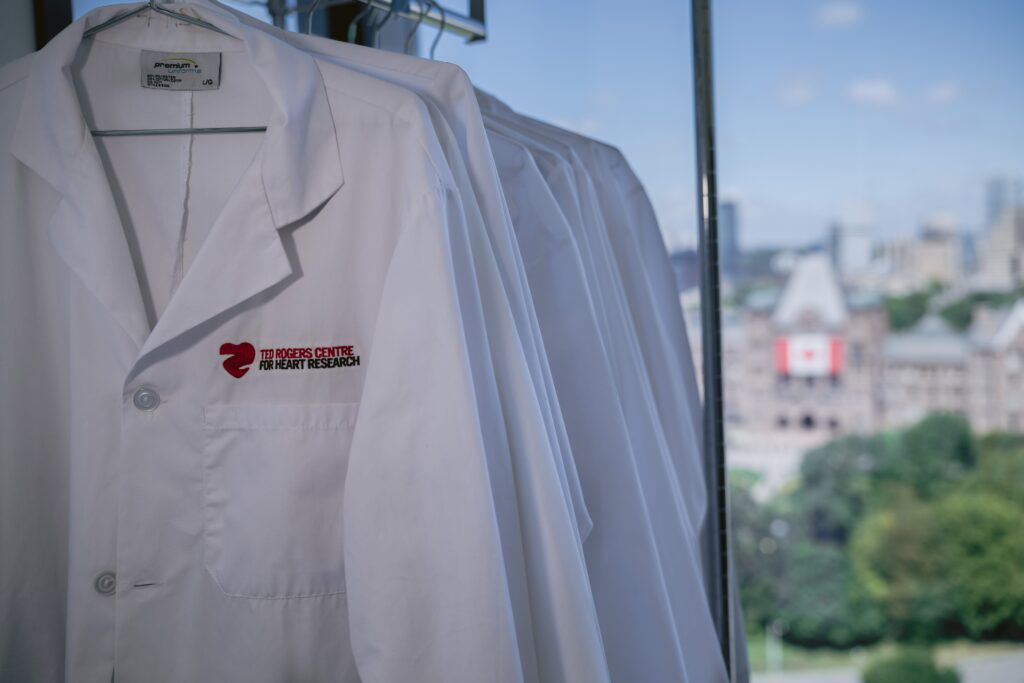
White lab coats with a Ted Rogers Centre for Heart Research logo hanging on a rack before a window overlooking the city, capturing life at the Ted Rogers Centre.