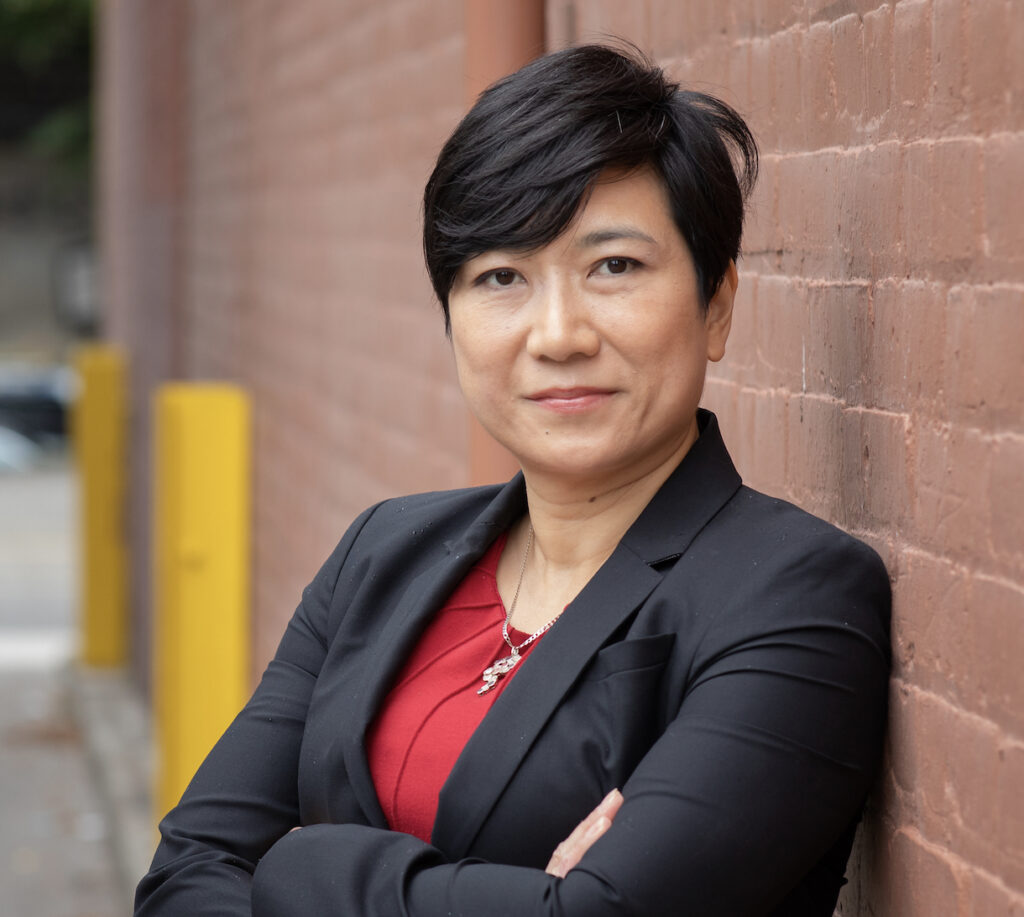
A person with short dark hair wearing a black blazer over a red top, posing against a brick wall.

Emily Seto

PhD, PEng

  • Associate Professor and Program Director of the Health Systems Research Program, Institute of Health Policy, Management and Evaluation (IHPME), University of Toronto
  • Research Scientist, Centre for Digital Therapeutics and Toronto General Hospital Research Institute, UHN
  • Co-Director, International Collaborative for Translational Digital Health, Universities of Toronto, Manchester, and Melbourne

Research Focus Areas

  • Accessible Virtual Care Innovations
  • Chronic Disease Management
  • Digital Health
  • Implementation Science
  • Remote Patient Monitoring

Overview

Emily Seto holds a Tier 1 Canada Research Chair in Accessible Virtual Care Innovations. She is an Associate Professor and the Director of the Health Systems Research Program at the Institute of Health Policy, Management and Evaluation at the University of Toronto. She is a Professional Engineer of Ontario, a Senior Scientist at the Centre for Digital Therapeutics and the Toronto General Hospital Research Institute at the University Health Network, and co-Director of the International Collaborative for Translational Digital Health.

Her research interests centre on digital health, remote patient management, heart failure self-care, and mHealth, spanning both the technical development of digital health tools and the harder problem of getting them adopted into routine clinical care. Among her greatest accomplishments, she co-developed Medly, a heart failure remote patient management program launched at the Peter Munk Cardiac Centre as part of standard of care in 2016. As another example, she also co-developed Raabta, a telemonitoring program for pregnant women at high risk for preeclampsia in Pakistan, highlighting her interests in global health.

She is the Principal Investigator of several past and current clinical trials using a variety of qualitative and quantitative methods. As an example, she is currently leading a multi-site propensity-matched trial in Ontario named the SMaRT (Safe, Managed, and Responsive Transitions) trial that is exploring the combination Medly (version supporting multiple chronic conditions) with a nurse-led model of care to improve outcomes of patients recently discharged from hospital, that was funded through a $1.2 million CIHR grant. She is also the Nominated Principal Investigator for a nearly $2 million CIHR grant, to expand Medly internationally to Australia and the United Kingdom, as well as Saskatchewan.

Collaborators would find her two decades of development and implementation science experience particularly valuable for projects moving from prototype into everyday clinical use.

Published Research

Showing 4 out of 56 results

  • Machine Learning in Palliative Care: Scoping Review of Applications.

    2026 | JMIR AI

    Marya Zaidi, Elham Dolatabadi, Peter Tanuseputro, Waqas Ullah Khan, Emily Seto

  • Barriers and Facilitators to Implementing Digital Health Technologies for Remote Management of NCDs in Rural Areas: Mixed Methods Systematic Review.

    2026 | Journal of medical Internet research

    Serine Sahakyan, Selai Akseer, Lusine Abrahamyan, Olivia Metcalf, Sara Allin, Richard Chenhall, Emily Seto

  • Development of Virtual Mental Health Stepped Care Service for a Heart Failure Remote Management Program: Qualitative Descriptive Study

    2026 | JMIR Formative Research

    Amika Shah, Anam Shahil-Feroz, Kathleen A Sheehan, Shannon Wright, Robert P Nolan, Gillian Strudwick, Sanjeev Sockalingam, Emily Seto

  • Carbon and Travel Cost Reduction From Remote Medication Titration for Advanced Heart Failure: A Secondary Analysis of a Randomized Controlled Trial.

    2025 | The Canadian journal of cardiology

    Elfassy MD, Runeckles K, Simms N, Anderson GM, Simard A, Brahmbhatt DH, Seto E, Lipscombe A, Faroutan F, Miller FA, Ross HJ, Medly Titrate Study Team

Research Laboratory

The Seto lab develops digital health innovations and evaluates them through clinical trials, using a mix of qualitative and quantitative methods to test whether virtual care technologies improve patient outcomes once deployed in real care settings. A focus of her work includes supporting the most vulnerable and underserved communities. Projects include determining ways to support elderly complex patients recently discharged from hospital, so that they don’t keep getting readmitted to hospital.

Her team is also investigating how to reimagine how patients interface with digital health technologies by leveraging AI and design techniques with the goal to enable all patients to access these tools equitably, regardless of language spoken and level of digital and health literacy. She has supervised over 60 current and past students including undergrads, graduate students, and post-doctoral trainees. The lab’s broader research draws on Seto’s background in biomedical engineering and health informatics to study not only whether digital health tools work, but how they should be equitably implemented, treating clinical effectiveness and real-world adoption as questions that need to be answered together rather than separately.

White lab coats with a Ted Rogers Centre for Heart Research logo hanging on a rack before a window overlooking the city, capturing life at the Ted Rogers Centre.