

Headshot of a smiling middle-aged East Asian man wearing glasses, a button-down shirt, and a dark blazer.

Yu Sun

PhD, PEng

  • Professor, Department of Mechanical and Industrial Engineering, University of Toronto
  • Tier 1 Canada Research Chair in Micro and Nano Engineering Systems

Research Focus Areas

  • Biosensors
  • Cell Mechanics
  • Cellular Mechanobiology
  • Instrumentation
  • Robotics and Automation

Overview

Yu Sun is a Professor in the Department of Mechanical and Industrial Engineering at the University of Toronto, jointly appointed in the Institute of Biomaterials and Biomedical Engineering and the Department of Electrical and Computer Engineering, and holds a Tier 1 Canada Research Chair in Micro and Nano Engineering Systems. His research interests center on micro/nano robotics, cell manipulation, microfluidic devices, and precision instrumentation, developing robotics and automation technologies capable of tasks such as injecting molecules directly into individual biological cells.

He was the founding Director of the University of Toronto Robotics Institute. He completed his PhD at the University of Minnesota, joined the University of Toronto in July 2004, and was promoted through associate and full professor by 2012; he was elected to the Canadian Academy of Engineering in 2014 and the Royal Society of Canada in 2019, and holds fellowships across numerous engineering societies such as IEEE and AIMBE. His group’s instruments include robotic microinjection systems, automated gap junction measurement systems, and microfluidic devices for measuring cardiomyocyte mechanical and electrical properties, work directly relevant to cardiovascular tissue engineering.

Collaborators would find his cell-manipulation instruments particularly valuable for measuring the mechanical or electrical properties of individual cardiomyocytes.

Published Research

Showing 4 out of 157 results

  • Automated Instance Segmentation Network for Overlapping Cells in Cleavage-Stage Embryos

    2026 | IEEE Transactions on Automation Science and Engineering

    Chen Sun, Hang Liu, Guanqiao Shan, An Hu, Haocong Song, Wenyuan Chen, Lei Chen, Shanshan Wang, Haixiang Sun, Yu Sun

  • A Hybrid Control Framework With Learning-Based Overshoot Compensation for Accurate Robotic Pouring

    2026 | IEEE Robotics and Automation Letters

    Yue Wang, Jiajun Su, Daohui Liu, Zheng Gong, Jiong Yang, Jidong Ye, Yaming Tian, Jiancai Huang, Xingjian Liu, Yu Sun

  • Automated Microscopy Video Object Detection of Motile Cells With Static-Dynamic Transformers

    2026 | IEEE Transactions on Automation Science and Engineering

    Haocong Song, Wenyuan Chen, Chen Sun, Selina Wan, Guanqiao Shan, Changsheng Dai, Hang Liu, Zhuoran Zhang, Yu Sun

  • Three-dimensional reconfigurable magnetic microswarms with boundary-transcending capabilities

    2026 | Science Advances

    Pengsong Zhang, Pengfei Xu, Peng Pan, Yuntong Sun, Shaojia Wang, Runze Zuo, Chongyu Zhang, Wentian Tang, Tiancong Wang, Yuhang Wang, Mingzhe Sun, Qiwu Zhang, Yuxiao Zhou, Yunkai Wang, Junyue Dai, Junhui Law, Wenkun Dou, Juntian Qu, Ren-Ke Li, Yu Sun, Xinyu Liu

Advanced Micro and Nanosystems Laboratory (AMNL)

The Advanced Micro and Nanosystems Laboratory (AMNL), founded by Yu Sun in 2004 and affiliated with the Departments of Mechanical and Industrial Engineering, Electrical and Computer Engineering, and Computer Science alongside the Institute of Biomedical Engineering, develops novel instruments, robotic systems, and algorithms spanning fundamental science to applied technology at the micro and nano scale. The lab’s work centers on micro- and nano-robotic manipulation, precision instrumentation, and automation at scales invisible to the naked eye, applied across several domains: robotic cell surgery and in vitro fertilization, personalized medicine for cardiac disease through robotic and microdevice-based drug screening, robotic cancer treatment for drug-resistant tumours, and cellular mechanobiology and biophysics. Its cardiac-relevant work includes instruments for measuring the mechanical and electrical properties of individual heart cells, directly supporting cardiovascular tissue engineering research elsewhere at the university. The lab has a multidisciplinary team spanning mechanical and electrical engineering, computer science, and biomedical engineering, and works with an extensive network of clinician scientists, biologists, and industry partners; several of its trainees have received Ted Rogers Centre for Heart Research Education Fund fellowships to support their doctoral work. AMNL has received recognition including the UofT Connaught Innovation Award (multiple years) and the President’s Impact Award from the University of Toronto.
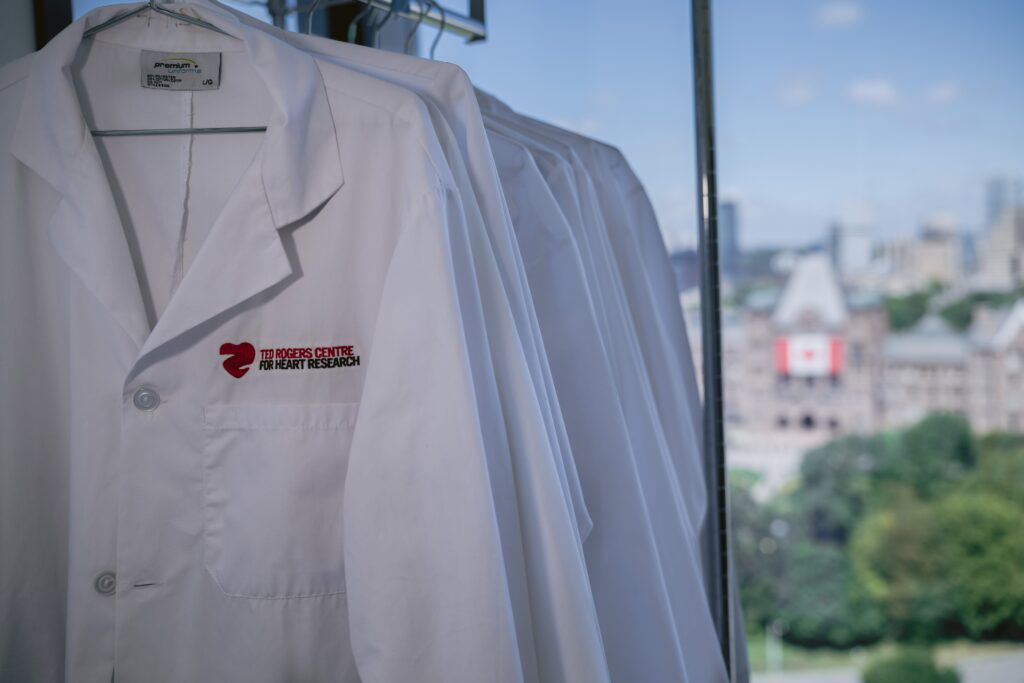

White lab coats with a Ted Rogers Centre for Heart Research logo hanging on a rack before a window overlooking the city, capturing life at the Ted Rogers Centre.