

A woman with dark hair wearing a black sleeveless top and a gold necklace.

Milica Radisic

PhD, PEng

  • Professor, Institute of Biomaterials and Biomedical Engineering and Department of Chemical Engineering and Applied Chemistry, University of Toronto
  • Tier 1 Canada Research Chair in Organ-on-a-Chip Engineering

Research Focus Areas

  • Biomaterials
  • Cardiac Tissue Engineering
  • Organ-on-a-Chip Engineering
  • Stem Cell-Derived Tissue

Overview

Milica Radisic is a Professor in the Institute of Biomaterials and Biomedical Engineering and the Department of Chemical Engineering and Applied Chemistry at the University of Toronto, and holds a Tier 1 Canada Research Chair in Organ-on-a-Chip Engineering. Her research interests centre on organ-on-a-chip engineering, cardiac tissue engineering, biomaterials, and stem cell-derived tissue; she has helped shape the emerging field of organ-on-a-chip technology and is known for creating beating heart tissue in a dish from human induced pluripotent stem cells.

Among her most significant achievements, her technology transfer work has produced 40 pieces of intellectual property and 4 licenses, and she co-founded two companies: TARA Biosystems (later acquired by Valo Health), which screens AI-designed drugs using engineered human heart tissue, and Quthero, which advances regenerative peptide materials now in dermatological clinical trials.

She was named a Fellow of the National Academy of Inventors and a Fellow of the International Union of Societies for Biomaterials Science and Engineering in 2024. She completed her BEng at McMaster University and her PhD at MIT, joining the University of Toronto in 2005, where she has since published more than 260 articles with over 16,000 citations. She co-founded the Centre for Research and Applications in Fluidic Technologies (CRAFT) with Aaron Wheeler.

Collaborators would find her organ-on-a-chip platforms particularly valuable for cardiac disease modelling and drug discovery projects.

Published Research

Showing 4 out of 93 results

  • 3D fractal topography attenuates inflammation and confers resilience to glomerular podocytes

    2026 | Cell Biomaterials

    Ying Wang, Caner Dikyol, Karl T. Wagner, Shira Landau, Chuan Liu, Sargol Okhovatian, David F. Bodenstein, Daniel Vosoughi, Yimu Zhao, Karen Shen, Amid Shakeri, Qinghua Wu, Milica Radisic

  • In vitro multi-organ invasion model for exploring cardiac resistance to cancer metastasis.

    2026 | Nature communications

    Amid Shakeri, Dhana Abdo, Matthew Ho Cheong Lei, Sargol Okhovatian, Garrett F. Beeghly, Anna Maria Popovic, Richard Jiang, Chuan Liu, Karl T. Wagner, Daniel Vosoughi, Jennifer Kieda, Jason E. Fish, Milica Radisic

  • Galectin-1 Modulates Cell Adhesions, Caveolae, and Vascular Permeability in Kidney Endothelial Cells – Insights from Proteomics, Phosphoproteomics, and Functional Studies

    2026 |

    Alex Boshart, Sofia Farkona, Shravanthi Rajasekar, Chiara Pastrello, Maya Allen, Stefan Petrovic, Kieran Manion, Slaghaniya Neupane, Sergi Clotet-Freixas, Hong Sang Choi, Anne-Marie Bulboaca, Rohan John, Allen Duong, Stephen Juvet, Milica Radisic, Juan Manuel Pérez Sáez, Gabriel A. Rabinovich, Sara Deir, Boyang Zhang, Igor Jurisica, Ana Konvalinka

  • Heart-on-a-chip and vasculature-on-a-chip platforms as models of cardiovascular disease.

    2026 | Nature reviews. Cardiology

    Khosravi R, Radisic M

Research Laboratory

The Radisic lab, formally the Laboratory for Functional Tissue Engineering, advances organ-on-a-chip technologies including Biowire, AngioChip, and inVADE to model human heart, kidney, and vascular diseases for drug discovery. Using microfabrication and 3D printing at CRAFT, the team scales up production of these devices while incorporating natural fractal cues to better mimic human physiology. Working with hospital collaborators, the lab uses patient-derived stem cells to model diseases including cardiomyopathies and transplant rejection, and has investigated how COVID-19 affects multiple organ systems. In parallel, the lab develops bioinspired, electroactive, biodegradable polymers with tailored mechanical and immunological properties for tissue engineering applications, including Injectable Tissue for minimally invasive delivery and Hook-in-Tissues for modular tissue assembly. A peptide the lab identified, derived from angiopoietin-1, supports healing across multiple tissue types and has advanced into dermatological clinical trials for post-surgical and cosmetic skin repair, illustrating the lab’s pattern of moving fundamental discoveries toward clinical and commercial application.
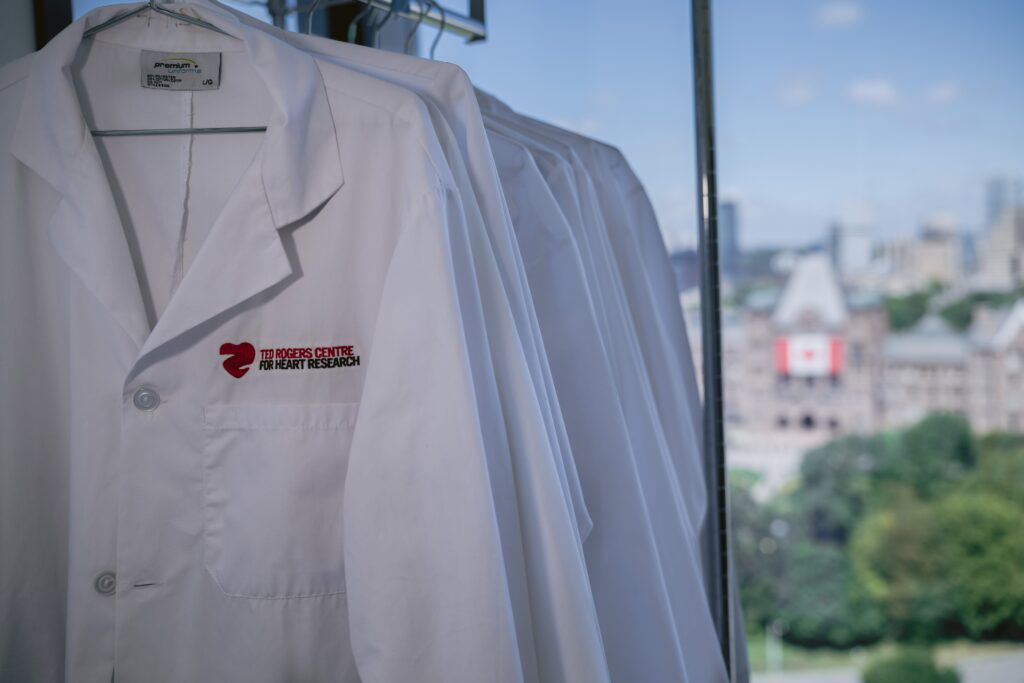

White lab coats with a Ted Rogers Centre for Heart Research logo hanging on a rack before a window overlooking the city, capturing life at the Ted Rogers Centre.